

SailPoint IdentityIQ-Engineer Cert Guide PDF 100% Cover Real Exam Questions
Pass IdentityIQ-Engineer Exam - Real Questions and Answers
SailPoint IdentityIQ-Engineer Exam Syllabus Topics:
| Topic | Details |
|---|---|
| Topic 1 |
|
| Topic 2 |
|
| Topic 3 |
|
| Topic 4 |
|
NEW QUESTION # 58
Is this a valid statement about connector rules?
Solution: A Post-Iterate Rule, if configured, is run after reading accounts from a SQL Loader application.
- A. Yes
- B. No
Answer: A
Explanation:
A Post-Iterate Rule in SailPoint IdentityIQ is a type of connector rule that is executed after each account from the source system (e.g., SQL Loader application) has been read during the aggregation process. This rule allows for additional processing or customization of the data after the account has been iterated over. According to SailPoint IdentityIQ documentation, configuring a Post-Iterate Rule enables the execution of logic after each account's data has been processed, confirming that the given statement is valid. Refer to the SailPoint IdentityIQ Connector Development Guide for detailed information on rule execution during aggregation.
NEW QUESTION # 59
Can the search type in Syslog be used to accomplish this result?
Solution: Launching a certification using the search results
- A. Yes
- B. No
Answer: A
Explanation:
Syslog cannot be used to launch a certification using the search results. Launching a certification in IdentityIQ is a process that involves interacting with the application's certification module, where you define parameters, select users or roles, and initiate the certification campaign. This process requires using the IdentityIQ user interface or APIs, not the Syslog, which is purely for logging purposes.
Reference:
SailPoint IdentityIQ Certification Guide
SailPoint IdentityIQ API and UI Guide
NEW QUESTION # 60
Can this action be performed as part of configuring an application definition in IdentitylQ?
Solution: Specify which users should be provisioned with a basic account as part of a joiner event.
- A. Yes
- B. No
Answer: A
Explanation:
Yes, this action can be performed as part of configuring an application definition in IdentityIQ. When defining an application, you can specify provisioning policies, including which users should be provisioned with a basic account as part of a joiner event. This is typically done by setting up account creation rules or provisioning policies that trigger when a new user (joiner) is detected, ensuring they receive the necessary basic accounts and entitlements.
Therefore, the correct answer is A. Yes.
NEW QUESTION # 61
Is the following statement true?
Solution: All ManagedAttribute objects associated to an Identity can be viewed on the 'Attributes' tab from 'View Identity' QuickLink.
- A. Yes
- B. No
Answer: B
Explanation:
Not all ManagedAttribute objects associated with an Identity are visible on the 'Attributes' tab within the 'View Identity' QuickLink. The 'Attributes' tab typically displays attributes that are specifically configured to be shown in the identity view, which might include certain managed attributes depending on how the system is configured. ManagedAttributes can represent various aspects like roles, entitlements, or even custom attributes, and their visibility on the UI depends on how the IdentityIQ instance is configured. To manage and configure visibility of attributes, consult the SailPoint IdentityIQ User Interface Customization Guide and Managed Attributes documentation.
Top of Form
Bottom of Form
NEW QUESTION # 62
An engineer needs to first create a custom audit event and then set up an associated report. What are four steps to accomplish this goal?
Solution: Create a Data Export task.
- A. Yes
- B. No
Answer: B
Explanation:
Creating a custom audit event and setting up an associated report involves steps such as defining the audit event, modifying the audit configuration, and creating a custom report using the SailPoint IdentityIQ reporting framework. Simply creating a Data Export task does not fulfill these requirements. A Data Export task is used for exporting data from IdentityIQ and is unrelated to the creation of custom audit events or custom reports. Refer to the SailPoint IdentityIQ Reporting Guide and the IdentityIQ Audit Framework documentation for more information on correctly creating and configuring custom audit events and reports.
NEW QUESTION # 63
Is this statement true about identitylQ's syslog event storage?
Solution: IdentitylQ logging events are stored in a database table in addition to log files.
- A. Yes
- B. No
Answer: B
Explanation:
The statement is false. While it is true that logging and auditing require extra function calls and generate data, the suggestion that this data can be compressed to avoid storage issues and improve performance is misleading. In practice, while compression might save storage space, it does not inherently improve performance, particularly because the overhead of compression and decompression could negate the performance benefits. Effective performance management in IdentityIQ involves more nuanced approaches, such as optimizing the level of detail in logs, managing log rotation, and tuning the system for efficient I/O operations.
Reference:
SailPoint IdentityIQ Logging and Auditing Guide
SailPoint IdentityIQ Performance Tuning Guide
NEW QUESTION # 64
Can this be achieved using Rapid Setup user interface configuration options?
Solution: Reassign all object ownership to the user's manager during Leaver and Termination events.
- A. Yes
- B. No
Answer: B
Explanation:
Reassigning all object ownership to a user's manager during Leaver and Termination events is a complex process that typically involves custom logic or workflows to ensure that all owned objects (like access, certifications, roles, etc.) are correctly reassigned.
The Rapid Setup interface is primarily designed for standard lifecycle management tasks, such as role assignments, account enabling/disabling, and certifications. It does not inherently support the automatic reassignment of object ownership based on lifecycle events such as Leaver and Termination events.
This kind of reassignment would typically require a custom rule or workflow to track and reassign all owned objects, which falls outside the scope of what Rapid Setup can handle directly. Therefore, the correct answer is B. No.
Reference:
This information is supported by the SailPoint IdentityIQ Lifecycle Manager Guide, which outlines what is possible through Rapid Setup and what would require custom development.
NEW QUESTION # 65
Is this a true statement about localization support in IdentitylQ?
Solution: Localized messages can be retrieved from custom Java/BeanShell code using SailPoint APIs.
- A. Yes
- B. No
Answer: A
Explanation:
IdentityIQ supports localization, allowing custom messages to be retrieved using SailPoint APIs within custom Java or BeanShell code. This capability is useful for creating applications that need to support multiple languages or regional formats. The SailPoint APIs provide methods to retrieve localized messages based on the current user's locale settings or other localization contexts.
Thus, the correct answer is A. Yes.
Reference:
This is based on the SailPoint IdentityIQ Developer Guide, which details how to use APIs for localization and how custom code can access localized messages within the platform.
NEW QUESTION # 66
An engineer needs to first create a custom audit event and then set up an associated report. What are four steps to accomplish this goal?
Solution:
- A. Yes
- B. No
Answer: B
Explanation:
The solution provided is incomplete. To create a custom audit event and set up an associated report, the process involves several steps, including defining the custom audit event in the Audit Configuration object, updating or creating relevant audit triggers in the system, and defining the custom report using XML or the IdentityIQ report editor. The steps mentioned in the solution do not cover the necessary configuration and implementation details required for this task. For a complete process, consult the SailPoint IdentityIQ Reporting Guide and the Audit Framework documentation.
NEW QUESTION # 67
Is this statement true about email templates or behavior within them?
Solution: Only identity object attributes or methods can be accessed through the reference variables of a template's input arguments.
- A. Yes
- B. No
Answer: B
Explanation:
The statement is incorrect. Email templates in SailPoint IdentityIQ are not restricted to just Identity object attributes or methods. They can access attributes and methods of any object passed to the template through its input arguments, including WorkItems, CertificationItems, and others. The template system allows the use of various objects' properties as long as they are properly referenced within the script or template context.
Reference:
SailPoint IdentityIQ Email Templates Guide
SailPoint IdentityIQ API Reference Documentation
NEW QUESTION # 68
The engineer needs to write some ad-hoc BeanShell code to search for GroupDefmition objects owned by Randy.Knight and print their names. Is this BeanShell code correct as written?
Solution:
- A. Yes
- B. No
Answer: B
Explanation:
The provided BeanShell code snippet attempts to filter and print the names of GroupDefinition objects owned by "Randy.Knight." However, the code contains a few issues that prevent it from functioning correctly as written:
Class Import: The GroupDefinition class should be imported explicitly at the beginning of the script, which is missing here.
Query Execution: The use of context.getObjectsByNumber(GroupDefinition.class, i) is incorrect. This method does not exist in this context. The correct approach would be to use context.getObjects() to retrieve the list of objects and iterate over them.
Looping Logic: The loop logic also contains a flaw. Instead of using a counter-based loop with context.getObjectsByNumber(), the recommended approach is to use context.search() to retrieve a list of filtered objects and then iterate through the results.
A corrected version of this code would look something like this:
import sailpoint.object.GroupDefinition;
import sailpoint.object.Filter;
import sailpoint.object.QueryOptions;
Filter filter = Filter.eq("owner.name", "Randy.Knight");
QueryOptions qo = new QueryOptions();
qo.addFilter(filter);
List<GroupDefinition> groupDefinitions = context.getObjects(GroupDefinition.class, qo); for (GroupDefinition group : groupDefinitions) { System.out.println(group.getName());
}
In this corrected version:
We explicitly import GroupDefinition.
We retrieve the filtered objects with context.getObjects(GroupDefinition.class, qo) instead of getObjectsByNumber.
Thus, the original code is not correct as written. The correct answer is B. No.
Reference:
This correction and explanation are based on SailPoint IdentityIQ's API documentation, which provides detailed guidance on the proper methods to retrieve and manipulate objects using Beanshell scripting within the platform.
NEW QUESTION # 69
Is this what should be performed in order to generate the database script to extend Application attributes in the IdentitylQ database on the initial installation?
Solution: Run a build with the updated schema placed inside it.
- A. Yes
- B. No
Answer: B
Explanation:
Running a build with the updated schema placed inside it is not the correct procedure to generate the database script to extend Application attributes in the IdentityIQ database during the initial installation. To extend the schema, you typically need to define the changes in a specific XML schema file and then generate the corresponding database scripts using IdentityIQ tools designed for schema extension. A build process does not inherently generate the required database scripts for extending attributes.
Reference:
SailPoint IdentityIQ Schema Configuration Guide
SailPoint IdentityIQ Installation and Setup Guide
NEW QUESTION # 70
A client wants users who belong to an IdentitylQ workgroup named Management to be able to request entitlements and roles, but only for other users whose location attribute is the same as theirs.
Is this a population that will achieve the goal?
Solution: Create a quicklink population, set the membership match list to "All," and set "Who can members request for?'' as share attributes with the requester, with the attribute set to location.'
- A. Yes
- B. No
Answer: A
Explanation:
This solution correctly addresses the client's requirement. By setting the membership match list to "All" and configuring "Who can members request for?" as "share attributes with the requester," with the attribute set to location, the system ensures that users in the "Management" workgroup can only request roles and entitlements for other users who share the same location. This setup effectively filters based on the location attribute, aligning with the client's needs.
Reference:
SailPoint IdentityIQ Quicklink Population Configuration Guide
SailPoint IdentityIQ Attribute-Based Access Control Guide
NEW QUESTION # 71
An IdentitylQ engineer needs to extend attributes in an IdentitylQ database after the database has been created.
What are the four minimum steps necessary to achieve this goal?
Drag four options from the left into the answer area on the right, and place them in the correct order.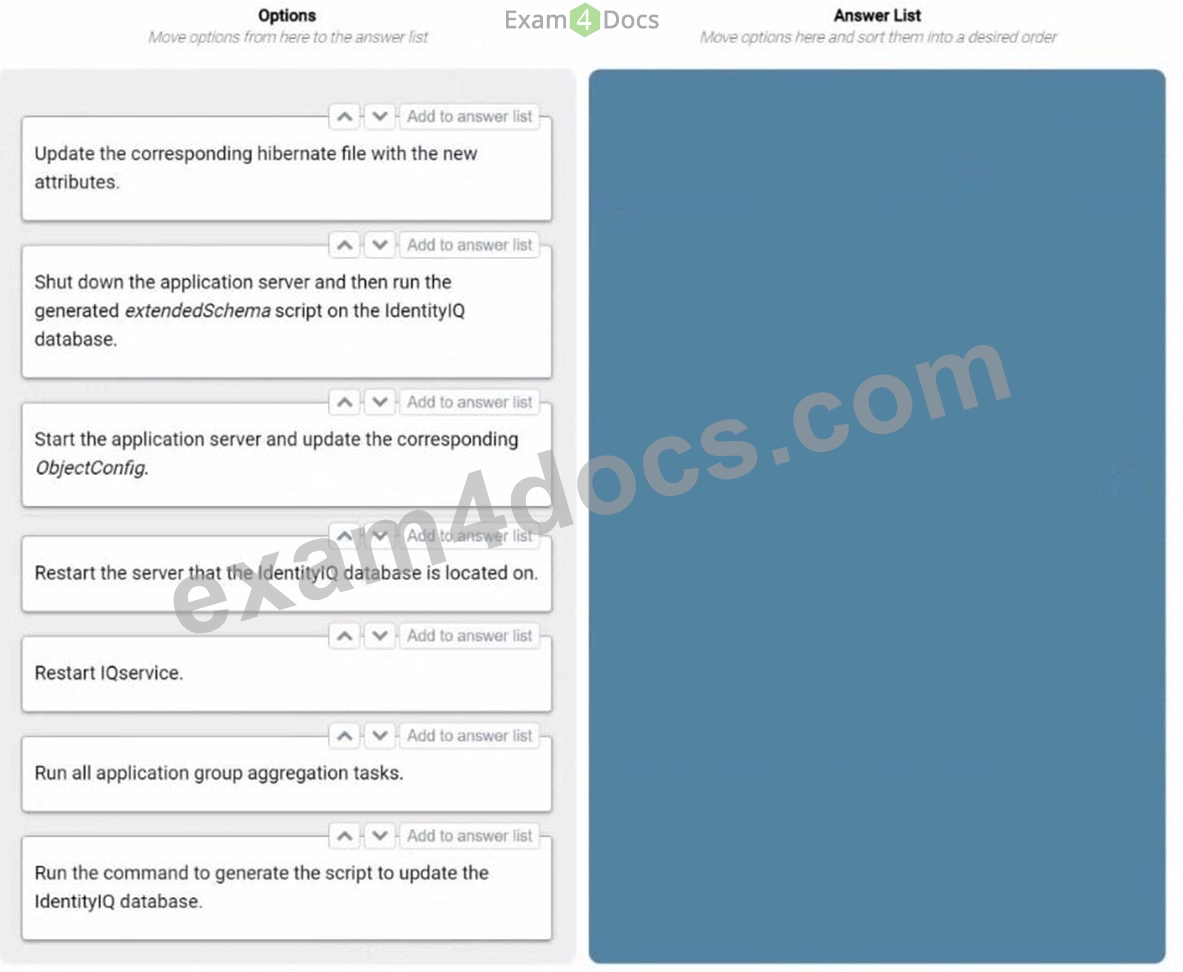
Answer:
Explanation: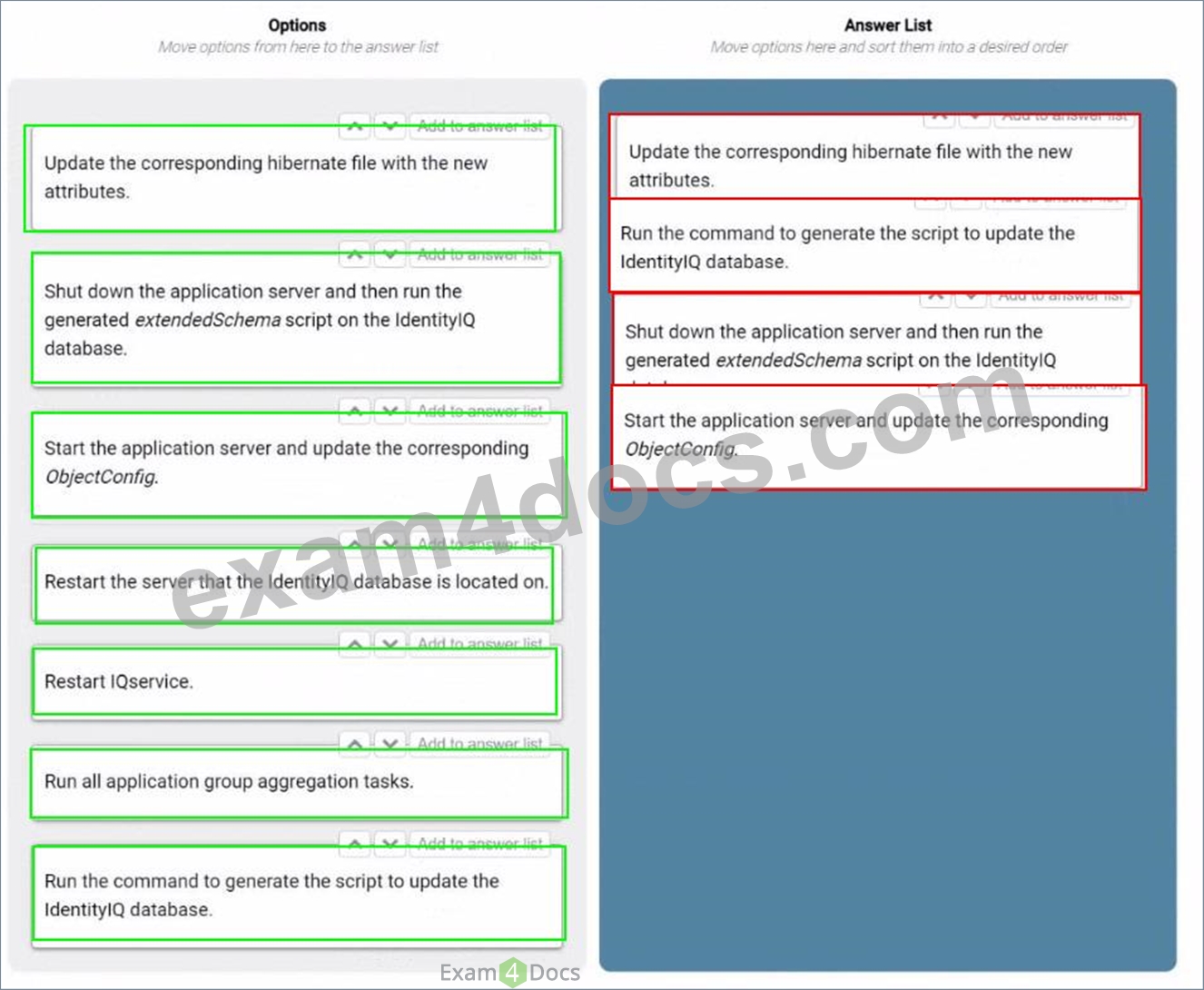
NEW QUESTION # 72
Can the following be achieved via configuration of control variables in the out-of-the-box Lifecycle Manager (LCM) workflows?
Solution: Disable all notifications.
- A. Yes
- B. No
Answer: A
Explanation:
Yes, disabling all notifications can be achieved via configuration of control variables in the out-of-the-box Lifecycle Manager (LCM) workflows. In SailPoint IdentityIQ, most workflows, including those in LCM, use control variables to manage various settings, such as whether notifications should be sent. By setting the appropriate control variable (e.g., disabling email notifications) within the workflow configuration, you can effectively suppress all notifications related to that workflow.
Therefore, the correct answer is A. Yes.
NEW QUESTION # 73
Is this statement correct about writing and executing source mapping rules to populate identity attributes?
Solution: The Identity object is passed to the rule.
- A. Yes
- B. No
Answer: A
Explanation:
The statement "The Identity object is passed to the rule" is correct. When writing source mapping rules to populate identity attributes, the Identity object is indeed passed to the rule. This allows the rule to access and modify attributes on the Identity object based on the logic defined within the rule.
Therefore, the correct answer is A. Yes.
NEW QUESTION # 74
Is this a valid step to take when importing SailPoint XML file objects into IdentitylQ?
Solution: Import the XML object through the IdentitylQ console.
- A. Yes
- B. No
Answer: A
Explanation:
Yes, this is a valid step to take when importing SailPoint XML file objects into IdentityIQ. The IdentityIQ console (iiq console) is a command-line tool used for various administrative tasks, including importing and exporting XML objects.
To import an XML object through the IdentityIQ console, the general procedure involves:
Navigating to the IdentityIQ installation directory.
Running the console with the import command:
iiq console import <filename>.xml
The console will process the XML file, importing the defined objects (roles, policies, identity mappings, etc.) into the IdentityIQ database.
This method is officially documented and is a common practice for importing configuration and objects into SailPoint IdentityIQ. Therefore, the answer is A. Yes.
Reference:
This explanation is derived from the SailPoint IdentityIQ Administration Guide, which details how to manage XML imports and exports using the IdentityIQ console tool.
NEW QUESTION # 75
Can the following action be performed using Rapid Setup application onboarding?
Solution: Specify the account attribute and value filter that identifies a secondary account.
- A. Yes
- B. No
Answer: B
Explanation:
Rapid Setup application onboarding is designed to simplify the initial configuration and does not typically provide advanced configuration options like specifying an account attribute and value filter to identify secondary accounts. Such detailed configurations often require custom scripting or detailed adjustments within the standard application setup, outside of the Rapid Setup interface.
Reference:
SailPoint IdentityIQ Rapid Setup Guide
SailPoint IdentityIQ Administration Guide (Sections on Application Onboarding and Advanced Account Mapping)
NEW QUESTION # 76
Is this statement true about email templates or behavior within them?
Solution: Whole paragraphs cannot be included or omitted based on conditional tests, such as #if (SremindersRemaining > 0). Only individual lines can be omitted in this manner.
- A. Yes
- B. No
Answer: B
Explanation:
This statement is incorrect. In SailPoint IdentityIQ email templates, entire blocks of text, including whole paragraphs, can indeed be conditionally included or omitted using the appropriate templating syntax such as #if, #else, and #end. The templating engine in IdentityIQ, which typically uses Apache Velocity, supports complex conditional logic that can control large sections of the email content, not just individual lines.
Reference:
SailPoint IdentityIQ Email Templates Guide
Apache Velocity Templating Guide for SailPoint IdentityIQ
NEW QUESTION # 77
An engineer is assigned to configure an account attribute. The requirements are:
Purpose: Flag privileged accounts
Read from: Financial application, privileged attribute
Calculate from: Keystore application, responsibility-code attribute
Usage 1: Display as option in Advanced Analytics
Usage 2: Use when writing rules
Usage 3: Include in policies
Does the engineer need to set this configuration option on the account attribute to meet the requirements?
Solution: Source Mappings: Application Rule
- A. Yes
- B. No
Answer: A
Explanation:
Yes, setting the "Source Mappings: Application Rule" configuration on the account attribute is necessary to meet the requirements described. The use case involves flagging privileged accounts based on attributes read from different applications and using these flags in various IdentityIQ features like Advanced Analytics, rule writing, and policy enforcement. By configuring the attribute with a source mapping that uses an Application Rule, you can implement complex logic to derive the attribute's value from multiple sources, such as a financial application and a keystore application, according to the specific requirements.
Therefore, the correct answer is A. Yes.
Reference:
This answer is based on the SailPoint IdentityIQ Implementation Guide, which discusses the use of source mappings and application rules for complex attribute calculations and configurations. The guide explains how to set up attributes that pull data from multiple sources and use this data across various IdentityIQ features.
NEW QUESTION # 78
Is this a default role type that is available in identitylQ?
Solution: Entitlement Role
- A. Yes
- B. No
Answer: B
Explanation:
In SailPoint IdentityIQ, the concept of a "role" is fundamental to the identity governance framework. The platform supports several default role types that are pre-configured to help organizations manage access effectively. The default role types include:
Business Role: Represents a collection of entitlements necessary for a specific job function within the organization.
IT Role: Aggregates technical entitlements that are typically assigned together, often linked to specific applications or systems.
Application Role: Tied to a specific application, representing roles within that application's context.
Composite Role: A combination of other roles, either business or IT, to form a higher-level role.
The term "Entitlement Role" is not recognized as a default role type in SailPoint IdentityIQ. While entitlements can be components of roles, "Entitlement Role" itself is not a predefined role type in the platform. Therefore, the correct answer is B. No.
Reference:
This answer is based on the SailPoint IdentityIQ Role Management Guide, which details the standard role types and their usage within the platform. The guide explicitly lists the supported default role types, and "Entitlement Role" is not among them.
NEW QUESTION # 79
The engineer is configuring a new application definition.
The customer wants an Audit record to be created with the error message, if provisioning fails.
Is this the rule an engineer should write to accomplish the goal?
Solution: Write an AfterProvisioning rule.
- A. Yes
- B. No
Answer: B
Explanation:
An AfterProvisioning rule in SailPoint IdentityIQ is typically used to execute custom logic after the provisioning process has been completed successfully. However, if provisioning fails, this rule will not be triggered because it is specifically designed for post-successful provisioning activities. To log an error message in the audit record when provisioning fails, a better approach would be to use a provisioning error handler or configure a specific workflow that captures errors and logs them accordingly. The AfterProvisioning rule is not the correct solution for this use case. Refer to the SailPoint IdentityIQ Provisioning and Workflow documentation for appropriate methods of handling provisioning errors and audit logging.
NEW QUESTION # 80
Is the following statement about IdentitylQ rule inputs and outputs correct?
Solution: A BeanShell rule in IdentitylQ must always return an object derived from the abstract class sailpoint.object.saiipointobject.
- A. Yes
- B. No
Answer: B
Explanation:
The statement that a BeanShell rule in IdentityIQ must always return an object derived from the abstract class sailpoint.object.SailPointObject is incorrect. While many rules in IdentityIQ may return objects that derive from SailPointObject, it is not a strict requirement. Rules can return various types of objects depending on their purpose and context. For example, a rule might return a String, Boolean, Map, or even null, depending on what the rule is designed to accomplish.
Therefore, the correct answer is B. No.
Reference:
This conclusion is drawn from the SailPoint IdentityIQ Rule Programming Guide, which explains that the return type of a rule can vary and does not need to be an instance of SailPointObject.
NEW QUESTION # 81
Can the search type in Syslog be used to accomplish this result?
Solution: Identifying all Link objects from a particular application
- A. Yes
- B. No
Answer: B
Explanation:
Syslog is not intended for querying or identifying specific objects, such as all Link objects from a particular application. Syslog is used to record events and log information related to system activities, errors, and operations. To identify all Link objects from a particular application, you would use IdentityIQ's internal search functionality or reports that allow you to filter and retrieve such objects. These tasks involve querying the database and application-specific data structures rather than examining log files.
Reference:
SailPoint IdentityIQ Administration Guide (Section on Objects and Searching) SailPoint IdentityIQ Configuration Guide (Understanding Link Objects)
NEW QUESTION # 82
......
100% Free IdentityIQ-Engineer Daily Practice Exam With 124 Questions: https://braindumps.exam4docs.com/IdentityIQ-Engineer-study-questions.html
