

[Oct 29, 2024] New P-SAPEA-2023 Exam Dumps with High Passing Rate
Get P-SAPEA-2023 Braindumps & P-SAPEA-2023 Real Exam Questions
NEW QUESTION # 16
You design a Solution Architecture, based on SAP S/4HANA, for an internationally active customer that has a national subsidiary in China and other countries that have special requirements for data storage. As the responsible Enterprise Architect, your task is to propose a solution that takes these special requirements into account. How do you proceed when your customer's Architecture Guideline calls for following a "cloud-first" approach?
- A. This is independent of the solution components required, because SAP S/4HANA Cloud and all SAP SaaS solutions meet all applicable data protection requirements, Private cloud or on-premises options therefore do not need to be considered. The "cloud-first" approach can be fully implemented.
- B. This depends on the required solution components. None of the selected SAP solutions may support the regulated environment, so alternative solutions or custom developed solutions should be considered.
- C. This depends on the required solution components. Public cloud solutions may not meet the necessary data protection requirements. Therefore, private cloud or on-premise options must be considered when developing the solution landscape.
Answer: C
Explanation:
The customer's architecture guideline calls for following a "cloud-first" approach, but this does not mean that all solutions must be deployed in the cloud. In some cases, private cloud or on-premise options may be necessary to meet the customer's data protection requirements.
For example, if the customer's subsidiary in China requires that data be stored within China, then a private cloud solution in China may be the best option. Similarly, if the customer's other subsidiaries have different data protection requirements, then a hybrid solution that combines cloud and on-premise deployments may be necessary.
The Enterprise Architect must carefully consider the customer's specific requirements and constraints before making a decision about the deployment environment.
Here are some of the factors that the Enterprise Architect should consider:
The customer's data protection requirements: The Enterprise Architect must understand the customer's specific data protection requirements and ensure that any solution meets those requirements.
The availability of cloud-based solutions that meet the customer's requirements: Not all cloud-based solutions meet the same data protection requirements. The Enterprise Architect must ensure that the cloud-based solutions that are being considered meet the customer's requirements.
The cost of different deployment options: The Enterprise Architect must consider the cost of different deployment options, including cloud, private cloud, and on-premise.
The scalability and performance requirements of the solution: The Enterprise Architect must ensure that the solution meets the customer's scalability and performance requirements, regardless of the deployment environment.
By carefully considering all of these factors, the Enterprise Architect can make a decision about the deployment environment that meets the customer's specific requirements and constraints.
NEW QUESTION # 17
As the Chief Enterprise Architect of Wanderlust GmbH, you are aware that EA principles should correlate to the Business and IT Strategic Objectives and decisions. In the list given below, the left column has some Wanderlust Business/IT objectives and decisions and the right column has some EA principles. Which objectives and decisions correlate best to which principle?
Answer:
Explanation: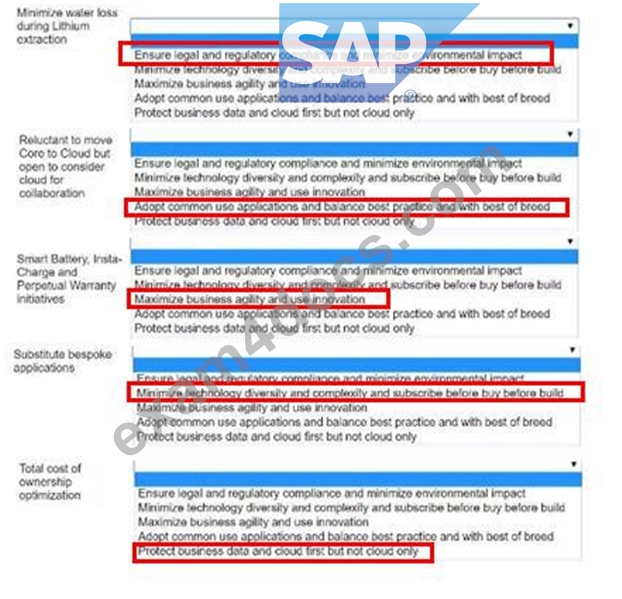
NEW QUESTION # 18
Which runtime environments does SAP directly support an SAP BTP?
- A. OpenJDK for Java applications/Openshift for Kubernetes
- B. SAP BTP, Cloud Foundry environment/SAP Business Technology Platform (BTP), ABAP environment/SAP BTP, Kyma runtime
- C. Kubemetes/SAP Business Technology Platform (BTP), ABAP environment
Answer: B
Explanation:
SAP Business Technology Platform (BTP) is a suite of cloud-based platform-as-a-service (PaaS) offerings from SAP. BTP provides a variety of runtime environments for running applications, including:
SAP BTP, Cloud Foundry environment: This is a popular runtime environment for running Java, Node.js, and Python applications.
SAP Business Technology Platform (BTP), ABAP environment: This is a runtime environment for running ABAP applications.
SAP BTP, Kyma runtime: This is a runtime environment for running Kubernetes-based applications.
In addition to these runtime environments, BTP also provides a number of other services, such as:
Database services: BTP provides a variety of database services, including SAP HANA, MySQL, and PostgreSQL.
Messaging services: BTP provides a variety of messaging services, such as SAP Cloud Platform Integration and SAP Cloud Platform Event Mesh.
Storage services: BTP provides a variety of storage services, such as SAP Cloud Platform Object Storage and SAP Cloud Platform File Storage.
BTP is a comprehensive platform that provides a variety of services for running applications and managing data. The different runtime environments available in BTP allow you to choose the right environment for your specific needs.
SAP BTP supports multiple runtime environments for different purposes and skill sets. A runtime environment is any runtime that hosts applications and services. An SAP BTP environment provides integration into the SAP BTP account model, cockpit, and permissions management10. The following are the runtime environments that SAP directly supports on SAP BTP:
SAP BTP, Cloud Foundry environment: This environment allows you to create polyglot cloud applications in Cloud Foundry. It supports various programming languages, such as Java, Node.js, Python, Go, and PHP. It also provides a code-to-container packaging and deployment model, platform-managed application security patching and updates, automatic application routing, load balancing, health checks, and multilevel self-healing. It also supports the Cloud Application Programming Model (CAP), which is an opinionated framework for developing business applications.
SAP Business Technology Platform (BTP), ABAP environment: This environment allows you to create ABAP-based cloud applications within the Cloud Foundry environment. It supports the ABAP programming language and the ABAP RESTful Programming Model (RAP), which is a framework for developing RESTful services and user interfaces. It also provides an integrated development lifecycle and enables you to reuse existing on-premise ABAP assets.
SAP BTP, Kyma runtime: This environment provides a fully managed cloud-native Kubernetes application runtime based on the open-source project "Kyma". It supports various programming languages and models, such as Node.js, Python, Go, Java, CAP, and serverless functions. It also provides a built-in service mesh, eventing framework, API gateway, service catalog, and service binding capabilities. It enables you to develop highly scalable, microservice-based applications and user-centric process extensions.
Verified : 10: https://help.sap.com/docs/btp/architecture-and-development-guide-for-industry-cloud-solutions/runtimes-environments-and-programming-models | : https://help.sap.com/docs/btp/sap-business-technology-platform/environments
NEW QUESTION # 19
When creating an application architecture roadmap, the WHAT and WHERE are defined in a rather straightforward way, while the WHOM may differ by context. Multiple roadmap clusters may apply a variety of WHOM dimensions. For example, procurement vs. asset management. Which of the following definitions are correct? Note. There are 3 correct answers to this question.
- A. Groups of Persons/Permanent Staff, Contracted Staff, Students/Business Expense/Operational expenditure/Capital expenditure
- B. Working model/Home office, head quarter, affiliate
- C. Material Groups/Products, raw materials. Spare parts/Direct Materials, indirect materials
- D. Asset Classes/Vehicles, Production Machines, Office Equipment
Answer: A,B,C
Explanation:
Explanation
The WHOM dimension of an application architecture roadmap defines the different groups of stakeholders or users that are involved in or affected by the application. The WHOM dimension can vary depending on the context and the scope of the roadmap. For example, in the context of procurement vs. asset management, the WHOM dimension could include material groups/products, groups of persons, and working model as possible clusters. These clusters represent different categories of items, people, and locations that are relevant for the procurement and asset management processes. For example:
Material groups/products: This cluster could include different types of materials or products that are procured or managed by the organization, such as raw materials, spare parts, direct materials, or indirect materials. These categories could have different requirements, standards, or regulations that affect the application architecture.
Groups of persons: This cluster could include different types of people that are involved in or benefit from the procurement and asset management processes, such as permanent staff, contracted staff, or students. These groups could have different roles, responsibilities, or access rights that affect the application architecture.
Working model: This cluster could include different modes or locations of work that are supported by the procurement and asset management processes, such as home office, head quarter, or affiliate. These modes or locations could have different technical, legal, or organizational implications that affect the application architecture.
The other option (A) is not a correct definition of a WHOM dimension cluster, because it does not represent a group of stakeholders or users, but rather a group of assets or resources that are managed by the organization.
Asset classes/vehicles, production machines, and office equipment are examples of WHAT dimension clusters, which define the different types of assets or resources that are relevant for the application architecture.
Verified References: Strategic Architecture Roadmap for Composable Enterprise Applications, What is an application architecture?, Phase C: Information Systems Architectures - Application Architecture
NEW QUESTION # 20
As an Enterprise Architect, you must ensure that future extensions to the Digital Core of the enterprise guarantee stable and reliable operations. The architecture guideline demands to follow the clean-core strategy. What does this demand ensure and entail?
- A. Extensions are kept strictly separate from the SAP application, Extensions are developed in accordance with the SAP Application Extension Methodology. Side-by-side extensibility options are always preferable to on-stack extensibility options.
- B. Extensions do not break an upgrade, and upgrades do not break an extension. Such extensions can access SAP business objects only through well defined, upgrade-stable interfaces.
- C. Extensions may access SAP tables directly and in a well-documented, clean way. Therefore, the code of extensions can be adapted quickly to accommodate future changes.
Answer: B
Explanation:
The clean-core strategy is fundamental to ensuring that the Digital Core remains stable and reliable during operations and future upgrades. By following this strategy, any extensions made are guaranteed not to affect the core system upgrades, and likewise, system upgrades will not disrupt the functionality of the extensions. This is achieved by using well-defined and stable interfaces for extensions to interact with SAP business objects, ensuring compatibility and stability across system updates.
= The SAP architecture guidelines which prescribe maintaining a clean core, detailing how to develop extensions that are compatible with SAP's upgrade strategy and protect the integrity of the core system.
NEW QUESTION # 21
What are important factors of the SAP BTP. Cloud Foundry environment during runtime that you need to consider?
- A. CPU capacity and memory size of the application
- B. Programming language and buildpacks
- C. Number of users and API calls
Answer: A
Explanation:
Explanation
The CPU capacity and memory size of the application are important factors that affect the performance and scalability of the application in the SAP BTP. Cloud Foundry environment during runtime. These factors determine how many instances of the application can run in parallel and how much workload they can handle.
Verified References: :
https://help.sap.com/viewer/65de2977205c403bbc107264b8eccf4b/Cloud/en-US/350356d1dc314d3199dca15bd2
NEW QUESTION # 22
Which of the following lists of SAP Enterprise Architecture artifacts support making informed Target Application Architecture decisions that are aligned with the strategic direction of a company?
- A. Stakeholder Map/Business Strategy Map/Solution Strategy/Architecture Roadmap
- B. Principles Standards, Guidelines/Solution Context/Baseline Business and Solution Architecture
- C. Solution Context/Solution Concept/Stakeholder Map/Baseline Business and Solution Architecture
Answer: A
Explanation:
To make informed decisions about the Target Application Architecture that are aligned with the strategic direction of a company, certain artifacts are necessary to ensure that there is a clear connection between the stakeholder needs, business strategy, and the architectural vision. Option A includes a Stakeholder Map, which identifies the key players and their interests; a Business Strategy Map, which outlines the strategic objectives; a Solution Strategy, which details the approach to achieve the objectives through solutions; and an Architecture Roadmap, which lays out the plan to move from the current to the future state. These artifacts together provide a comprehensive view that guides the Target Application Architecture towards aligning with the company's strategic direction.
Reference:
Enterprise Architecture frameworks and methodologies that outline the use of strategic artifacts in architecture development.
Guidelines on creating architecture roadmaps that align with business strategies.
NEW QUESTION # 23
Your company adapts SAP's Integration Solution Advisory Methodology (ISA-M) as an Integration Solution Playbook. In your role as Lead Enterprise Architect, you are asked to decide which integration approach to take for this solution. Which of the following approaches is recommended by SAP ISA-M for identifying an integration solution and strategy?
- A. 1.Retrieve the documentation for the solutions that need to be integrated and identify best practices and recommendations for their integration./2. Assess existing integration components for re-use./3. Identify white spots and find suitable integration solutions that can cover them./4. Define Integration best practices and governance processes.
- B. 1.Document and review the existing integration (architecture)/2. Scope focus areas, for example future required building blocks/3. Find suitable integration technology for the required building blocks /4. Define Integration best practices and governance processes./5. Rollout the integration solutions in a staged approach
- C. 1.Document and review the existing integration (architecture)./2. Scope focus areas, for example future required building blocks/3. Identify architecture relevant use-cases (technology agnostic/clustered in use-case patterns)/4. Map these use case patterns to integration technology./5. Define Integration Best Practices./6. Enable a Practice of Empowerment.
Answer: C
Explanation:
The best answer for the integration approach to take for this solution is C. According to the SAP Integration Solution Advisory Methodology (ISA-M), which is a methodology offered by SAP that helps enterprise architects define an integration strategy for their organizations and derive related integration guidelines, the recommended approach for identifying an integration solution and strategy is:
Document and review the existing integration (architecture). This step involves documenting and analyzing the current state of the integration landscape, including the integration scenarios, technologies, patterns, standards, and governance processes. The goal is to understand the strengths and weaknesses of the existing integration (architecture) and identify the gaps and improvement areas.
Scope focus areas, for example future required building blocks. This step involves defining and prioritizing the focus areas for the integration project, such as new or changed business requirements, integration scenarios, or technologies. The focus areas are derived from the gaps and improvement areas identified in the previous step, as well as from the business goals and drivers of the organization. The focus areas are also mapped to future required building blocks, which are logical components that represent the desired capabilities or functionalities of the integration solution.
Identify architecture relevant use-cases (technology agnostic/clustered in use-case patterns). This step involves identifying and describing the use-cases that are relevant for the integration project, such as process integration, data integration, user integration, or thing integration. The use-cases are technology agnostic, meaning that they do not specify any particular technology or service for implementation. The use-cases are also clustered in use-case patterns, which are generic templates that capture the common characteristics and requirements of similar use-cases.
Map these use case patterns to integration technology. This step involves mapping the use-case patterns to suitable integration technologies or services that can implement them. The mapping is based on a set of criteria and decision tables that consider various aspects of the use-case patterns, such as complexity, performance, security, or scalability. The mapping also takes into account the existing or planned integration technologies or services in the organization's landscape.
Define Integration Best Practices. This step involves defining and documenting the best practices and guidelines for designing, developing, testing, deploying, monitoring, and governing the integration solutions. The best practices and guidelines are based on SAP's recommendations and industry standards, as well as on the organization's specific needs and preferences. The best practices and guidelines also cover various aspects of the integration project, such as naming conventions, error handling, logging, tracing, or versioning.
Enable a Practice of Empowerment. This step involves enabling and empowering the different roles and personas involved in the integration project, such as integration architects, developers, testers, operators, or business users. The goal is to foster a culture of collaboration and innovation among the stakeholders, and to provide them with the necessary skills, tools, and resources to execute their tasks effectively and efficiently.
The other options (A and B) are not correct for the integration approach to take for this solution, because they either skip or misrepresent some of the steps in the SAP Integration Solution Advisory Methodology (ISA-M). For example:
Option A is not correct because it does not include identifying architecture relevant use-cases (technology agnostic/clustered in use-case patterns), which is a key step to define and categorize the integration requirements in a generic way. It also does not include enabling a practice of empowerment, which is a key step to ensure the success and sustainability of the integration project.
Option B is not correct because it does not include documenting and reviewing the existing integration (architecture), which is a key step to understand the current state of the integration landscape and identify the gaps and improvement areas. It also does not include scoping focus areas or mapping use case patterns to integration technology, which are key steps to define and prioritize the future state of the integration solution.
For more information on the SAP Integration Solution Advisory Methodology (ISA-M) and its steps, you can refer to SAP Integration Solution Advisory Methodology: Template version 4.0 available now | SAP Blogs or Integration Solution Advisory Methodology (ISA-M): Define Integration Guidelines for Your Organization | SAP Blogs.
NEW QUESTION # 24
As a result of solution mapping, business capabilities might require services which partners have implemented in SAP BTP. Which SAP components and services, if any, are required to integrate such BTP partner services with an on-premise SAP S/4HANA system (hybrid scenario)?
- A. SAP HANA Cloud Connection, and the corresponding SAP Data Provisioning Agent, to make the on-premises system available to applications and services in a given SAP BTP sub account. Preferably use the SAP BTP Destination Service.
- B. SAP Cloud Connector to make the on-premises system available to applications and services in a given SAP BTP sub account. Preferably use the SAP BTP Destination Service in combination with Cloud Connector.
- C. No other components are required to make an SAP on-premise backend system securely accessible over SAP BTP SAP BTP automatically establishes secure connections in SAP backend systems.
Answer: B
Explanation:
Explanation
In a hybrid scenario, where business capabilities require services which partners have implemented in SAP BTP and an on-premise SAP S/4HANA system, the following SAP components and services are required to integrate such BTP partner services with the on-premise system:
SAP Cloud Connector: The SAP Cloud Connector is a software component that allows you to connect your on-premise SAP systems to SAP BTP. The Cloud Connector provides a secure connection between your on-premise system and SAP BTP, and it also makes your on-premise system available to applications and services in SAP BTP.
SAP BTP Destination Service: The SAP BTP Destination Service is a service that provides a single point of entry for accessing on-premise systems from SAP BTP. The Destination Service makes it easy to manage and secure connections to on-premise systems, and it also provides a way to federate data from different on-premise systems.
In order to integrate BTP partner services with an on-premise SAP S/4HANA system, you will need to install the SAP Cloud Connector on your on-premise system and register the Cloud Connector with SAP BTP. You will also need to create a destination in the SAP BTP Destination Service for your on-premise system. Once you have done this, you will be able to access the on-premise system from applications and services in SAP BTP.
It is important to note that you can also use other SAP components to integrate on-premise systems with SAP BTP. However, the SAP Cloud Connector and the SAP BTP Destination Service are the most commonly used components for this purpose.
To integrate BTP partner services with an on-premise SAP S/4HANA system, you need to use the SAP Cloud Connector, which is a reverse proxy that establishes a secure connection between your on-premise system and your SAP BTP subaccount5. The Cloud Connector acts as a bridge between your on-premise network and a trusted subaccount on SAP BTP6. It allows you to access resources in your on-premise network from applications running on SAP BTP without exposing your internal landscape to the internet7.
To simplify the configuration and consumption of the Cloud Connector connection, you can use the SAP BTP Destination Service, which is a service that allows you to define and manage destinations for accessing remote systems from applications running on SAP BTP8. A destination is a set of properties that contains information such as the URL, authentication method, proxy type, and additional parameters of a remote system9. By using the Destination Service, you can centrally manage and securely store the connection details of your on-premise system and consume them from your BTP partner services.
Verified References: 5:
https://help.sap.com/viewer/cca91383641e40ffbe03bdc78f00f681/Cloud/en-US/e6c7616abb5710148cfcf3e75d96
| 6:
https://help.sap.com/viewer/cca91383641e40ffbe03bdc78f00f681/Cloud/en-US/8d3b28a7c1644a1c9d1ee165ec0
| 7:
https://help.sap.com/viewer/cca91383641e40ffbe03bdc78f00f681/Cloud/en-US/e54cc8fbbb571014a4d9e7f02f9f
| 8:
https://help.sap.com/viewer/cca91383641e40ffbe03bdc78f00f681/Cloud/en-US/3cb7b81115c44cf594e0e363129
| 9:
https://help.sap.com/viewer/cca91383641e40ffbe03bdc78f00f681/Cloud/en-US/e54f70d327154aa0a4ba36ce7ac4
NEW QUESTION # 25
You, as the Chief Enterprise Architect of Wanderlust GmbH, have been trying to formulate the Business Strategy Map. You are currently working on the strategic objective to "Increase supply reliability of Lithium batteries". Arrange the elements of the Business Strategy Map into the right order that shows the dependencies between these elements.
Answer:
Explanation:
NEW QUESTION # 26
Tho Wanderlust CIO wants to focus loss on marketing strategy and planning, to instead prioritize marketing implement goals in mind to enhance number of leads generated:
* Run effective and highly visible campaigns (for example. on social media)
* Increase cross selling opportunities through online recommendation
AS the Chief Enterprise Architect Of Wanderlust. assisted by the SAP Enterprise Architects, you have been trying to re goals with the Business Process Modules, Segments and Activities in the Lead to Cash B2C Business Process Varia Business Architecture content repository (see graphic below).
What are relevant combinations Of business activities and goals based on the graphic below?
Note: There are 2 correct answers to this question.
See the Image
- A. Analyse and respond to customer insight- increase cross selling opportunities through online recommendations.
- B. Design and mange a customer loyalty program- increase cross selling opportunities through online recommendations.
- C. Implement promotional activities-Run effective and high visibility campaigns.
- D. Develop market strategy -Run effective and high visibility campaigns.
Answer: A,C
Explanation:
Explanation
Analyse and respond to customer insight is a business activity that is related to the Customer Insight segment of the Lead to Cash B2C Business Process Variant. This business activity can help Wanderlust to identify opportunities to increase cross selling through online recommendations.
Implement promotional activities is a business activity that is related to the Promotion segment of the Lead to Cash B2C Business Process Variant. This business activity can help Wanderlust to run effective and highly visible campaigns on social media.
The other two options, Develop market strategy and Design and mange a customer loyalty program, are not as relevant to the goals that Wanderlust is trying to achieve.
Develop market strategy is a business activity that is related to the Marketing Strategy segment of the Lead to Cash B2C Business Process Variant. This business activity is more focused on the overall marketing strategy of Wanderlust, rather than the specific goals of increasing cross selling or running effective campaigns.
Design and mange a customer loyalty program is a business activity that is related to the Customer Relationship Management segment of the Lead to Cash B2C Business Process Variant. This business activity is more focused on building long-term relationships with customers, rather than the specific goals of increasing cross selling or running effective campaigns.
Therefore, the best course of action is to focus on the Analyse and respond to customer insight and Implement promotional activities business activities in order to achieve Wanderlust's goals of increasing cross selling and running effective campaigns.
NEW QUESTION # 27
The Wanderlust CIO, along with you, the Chief Enterprise Architect, are in the process of deciding on the application that can potentially replace your existing online marketing application, and you are trying to create the artifact Business Footprint Diagram for decision support ( See table below) Which of the following combinations of goals, business capabilities, and applications would you recommend? Note: There are 2 correct answers to this question,
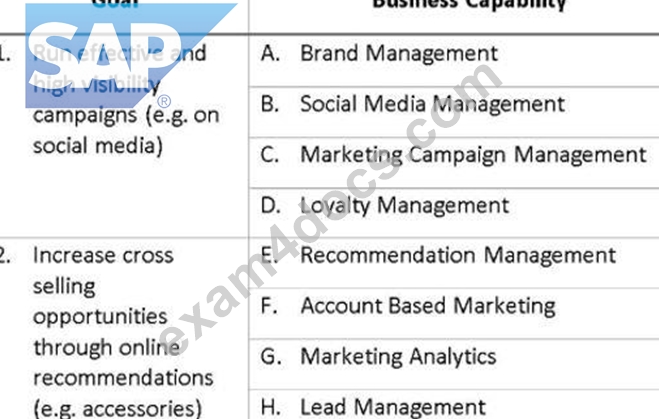

- A. 1-D-3,1-H- 2
- B. 1-B-3,1-C-3
- C. 2-A-4,1-F-2
- D. 2-E-3,2-G-3,2-B-3
Answer: B,C
NEW QUESTION # 28
Which artifacts does SAP provide as part of the SAP Reference Business Architecture content?
- A. Business Capability Model/Business Data Model/Business Role Model/Product Map
- B. Business Process Model/Solution Process Model
- C. Business Capability Model/Business Process Model
Answer: C
NEW QUESTION # 29
For the next Architecture Board meeting, you need to determine the next steps required after the business, application/data and technology architecture designs have been created. What do you recommend?
- A. Establishing change management processes for the management of the business application/data and technology artifacts Handing over the artifacts to the implementation partner and rolling out the project
- B. Finalizing the Business, Application/Data, and Technology Architecture artifacts. Building an Architecture Roadmap. Creating a first draft of the Project/Rollout Project plan.
- C. Reviewing Business Application/Data and Technology Architecture artifacts with stakeholders and signing off on first versions.Using Transition Architectures to build the Architecture Roadmap. Creating first drafts of the required work packages and the Project/Rollout plan.
Answer: C
Explanation:
Explanation
According to the SAP Enterprise Architect framework, which is based on the TOGAF ADM, the next steps are:
Reviewing Business, Application/Data, and Technology Architecture artifacts with stakeholders and signing off on first versions. This step involves validating and verifying the architecture designs with the relevant stakeholders, such as business owners, users, developers, and vendors. The goal is to ensure that the architecture designs meet the requirements and expectations of the project, and to obtain formal approval for the first versions of the artifacts.
Using Transition Architectures to build the Architecture Roadmap. This step involves defining and prioritizing the Transition Architectures, which are intermediate states between the Baseline Architecture (the current situation) and the Target Architecture (the desired future state). The Transition Architectures describe how to move from one state to another in a feasible and manageable way, taking into account the constraints and dependencies of the project. The Architecture Roadmap is a document that outlines the sequence and timing of the Transition Architectures, as well as the deliverables, resources, and risks associated with each one.
Creating first drafts of the required work packages and the Project/Rollout plan. This step involves identifying and defining the work packages, which are units of work that can be assigned to a project team or a vendor for implementation. The work packages specify the scope, objectives, dependencies, assumptions, and acceptance criteria of each unit of work. The Project/Rollout plan is a document that describes how to execute and monitor the work packages, as well as how to manage the change management, quality assurance, and governance aspects of the project.
The other options (B and C) are not correct for the next steps required after the architecture designs have been created, because they either skip or misrepresent some of the steps in the SAP Enterprise Architect framework.
For example:
Option B is not correct because it does not include reviewing and signing off on the first versions of the architecture artifacts with stakeholders, which is an important step to ensure alignment and agreement on the architecture designs. It also does not mention using Transition Architectures to build the Architecture Roadmap, which is a key step to define and prioritize the intermediate states between the Baseline and Target Architectures.
Option C is not correct because it does not follow the SAP Enterprise Architect framework at all. It suggests establishing change management processes for the management of the architecture artifacts, which is something that should be done earlier in the framework, not after creating the architecture designs. It also suggests handing over the artifacts to the implementation partner and rolling out the project, which is a premature and risky move that does not take into account the need for defining Transition Architectures, work packages, and Project/Rollout plan.
For more information on the SAP Enterprise Architect framework and its phases, you can refer to SAP Enterprise Architect | SAP Learning or SAP Certified Professional - SAP Enterprise Architect.
NEW QUESTION # 30
Demand and Supply Planning (SAP IBP) implementation has been identified as a quick win, based on feedback from a large cross section of Wanderlust stakeholders. As the Chief Enterprise Architect, you have now been asked to scope and contextualize the architecture project. Architecture principles have already been adopted. Which of the following activities should you to initiate to conclude the Statement of Architecture Work for the intended SAP IBP implementation initiative? Note: There are 3 correct answers to this question.
- A. Outline the aspirational Solution Concept to address the stakeholders' needs and business requirements.
- B. Conduct a Fit Gap Assessment to identify requirements that cannot be met
- C. Conduct a technical Proof of Concept to understand features and functionalities of SAP IBP.
- D. Define the Solution Context for the architecture work.
- E. Conduct a high-level Capability Assessment to identify areas of improvement (business and IT).
Answer: A,B,D
Explanation:
The Statement of Architecture Work should encompass a Fit Gap Assessment to understand what requirements are currently not met by existing capabilities, the definition of the Solution Context to set the boundaries and scope of the architecture project, and the outline of the aspirational Solution Concept that encapsulates the stakeholders' needs and business requirements. These steps are vital in the preparatory phase to ensure that the architecture work is well-defined and targeted to deliver the anticipated outcomes.
Reference = These activities are part of standard enterprise architecture practices and are necessary to develop a comprehensive and actionable Statement of Architecture Work that guides the SAP IBP implementation initiative.
NEW QUESTION # 31
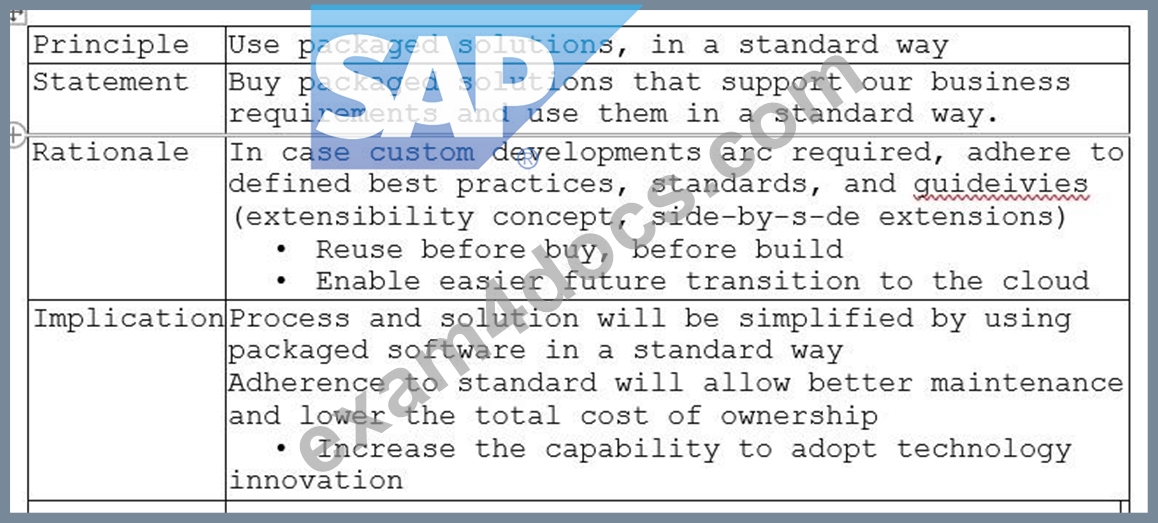
Green Elk & Company is the world's leading manufacturer of agricultural and forestry machinery. The former company slogan "Elk always runs has recently been changed to Elk feeds the world". One of Green Elk's strategic goals is to increase its revenue in the emerging markets of China, India, and other parts of Asia by 80 % within three years. This requires a new business model that caters to significantly smaller farms with limited budgets. You are the Chief Enterprise Architect and the CIO asks you to assess the new business model for smaller farms with smaller budgets. Given the principle and statement, which of the following combinations of rationale and implication do you consider well-defined?
- A.

- B.

- C.

- D.
Answer: A
Explanation:
The rationale and implication in this combination are well-defined because they both support the principle of using packaged solutions in a standard way. The rationale explains the benefits of using packaged solutions, while the implication outlines the steps that need to be taken to ensure that packaged solutions are used in a standard way.
According to the SAP Enterprise Architecture Framework, which is a methodology and toolset by the German multinational software company SAP that helps enterprise architects define and implement an architecture strategy for their organizations, a principle is a general rule or guideline that expresses a fundamental value or belief, and that guides the design and implementation of the architecture. A principle consists of four elements: a name, a statement, a rationale, and an implication. The name is a short and memorable label that summarizes the principle. The statement is a concise and precise description of the principle. The rationale is an explanation of why the principle is important and beneficial for the organization. The implication is a description of the consequences or impacts of applying or not applying the principle.
The principle in option D is:
Name: Use packaged solutions, in a standard way.
Statement: Buy packaged solutions that support our business requirements and use them in a standard way.
Rationale: Process and solution will be simplified by using packaged software in a standard way. Adherence to standard will allow better maintenance and lower the total cost of ownership. Increase the capability to adopt technology innovation.
Implication: In case custom developments are required, adhere to defined best practices, standards, and guidelines (extensibility concept, side-by-side extensions). Reuse before buy, before build. Enable easier transition to the cloud in the future.
This combination of rationale and implication is well-defined because it clearly and logically explains the benefits and consequences of following or not following the principle. The rationale shows how using packaged solutions in a standard way can simplify the process and solution, reduce the cost and effort of maintenance, and increase the ability to adopt new technologies. The implication shows how custom developments should be minimized and standardized, how reuse should be preferred over buying or building new solutions, and how cloud readiness should be considered for future scalability.
The other options (A, B, C) are not correct for the combination of rationale and implication that is well-defined because they either mix up or confuse some of the elements of the principle. For example:
Option A is not correct because it mixes up the rationale and implication elements. The first sentence of the rationale ("Process and solution will be simplified by using packaged software in a standard way") is actually an implication of following the principle, not a reason for following it. The first sentence of the implication ("Reuse vendor and industry best practices, reference architectures and pre-delivered content") is actually a rationale for following the principle, not a consequence of following it.
Option B is not correct because it confuses the rationale and implication elements. The first sentence of the rationale ("In case custom developments are required, adhere to defined best practices, standards, and guidelines (extensibility concept, side-by-side extensions)") is actually an implication of following the principle, not a reason for following it. The first sentence of the implication ("Process and solution will be simplified by using packaged software in a standard way") is actually a rationale for following the principle, not a consequence of following it.
Option C is not correct because it confuses the rationale and implication elements. The second sentence of the rationale ("Adherence to standard will allow better maintenance and lower the total cost of ownership") is actually an implication of following the principle, not a reason for following it. The second sentence of the implication ("Reuse before buy, before build") is actually a rationale for following the principle, not a consequence of following it.
NEW QUESTION # 32
When creating an application architecture roadmap, the WHAT and WHERE are defined in a rather straightforward way, while the WHOM may differ by context. Multiple roadmap clusters may apply a variety of WHOM dimensions. For example, procurement vs. asset management. Which of the following definitions are correct? Note. There are 3 correct answers to this question.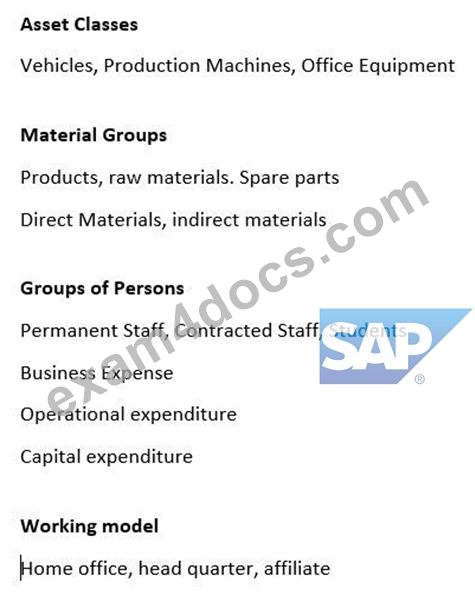
- A. Groups of Persons/Permanent Staff, Contracted Staff, Students/Business Expense/Operational expenditure/Capital expenditure
- B. Working model/Home office, head quarter, affiliate
- C. Asset Classes/Vehicles, Production Machines, Office Equipment
- D. Material Groups/Products, raw materials. Spare parts/Direct Materials, indirect materials
Answer: A,C,D
Explanation:
When creating an application architecture roadmap, the 'WHOM' dimension can vary greatly depending on the context of the roadmap's focus area. The 'WHOM' might refer to different stakeholders, systems, or units within an organization.
Option A is correct as 'Asset Classes' like Vehicles, Production Machines, and Office Equipment represent tangible assets managed by the organization's asset management processes.
Option B is also correct because 'Material Groups' such as Products, Raw Materials, and Spare Parts are categorized under procurement and inventory management, which are key components in defining the application architecture for those business functions.
Option C is incorrect because it combines 'Groups of Persons' with financial expenditure categories, which are not relevant to the 'WHOM' in the context of application architecture.
Option D is correct. The 'Working model' such as Home office, Headquarter, or Affiliate represents different organizational structures or geographical locations that may have distinct technology needs and are considered in the 'WHOM' dimension of an application architecture roadmap.
Reference:
SAP EA Designer documentation or user guides explaining how to define the dimensions of an application architecture roadmap.
Architectural standards and practices that outline the creation of roadmaps and the considerations for 'WHOM' in application architecture.
NEW QUESTION # 33
......
P-SAPEA-2023 Dumps To Pass SAP Exam in 24 Hours - Exam4Docs: https://braindumps.exam4docs.com/P-SAPEA-2023-study-questions.html
