

Get 100% Success with Latest Paloalto Network Security Administrator PCNSA Exam Dumps Aug 07, 2024
The Best PCNSA Exam Study Material and Preparation Test Question Dumps
The PCNSA certification exam is a comprehensive exam that consists of multiple-choice questions. PCNSA exam is administered through Pearson VUE, a leading provider of certification exams. PCNSA exam is timed and candidates have a total of 90 minutes to complete it. The passing score for the exam is 70%, and candidates who successfully pass the exam will receive the PCNSA certification.
NEW QUESTION # 181
Which two protocols are available on a Palo Alto Networks Firewall Interface Management Profile? (Choose two.)
- A. RDP
- B. SSH
- C. HTTPS
- D. SCP
Answer: B,C
NEW QUESTION # 182
Your company is highly concerned with their Intellectual property being accessed by unauthorized resources. There is a mature process to store and include metadata tags for all confidential documents.
Which Security profile can further ensure that these documents do not exit the corporate network?
- A. Anti-Spyware
- B. File Blocking
- C. URL Filtering
- D. Data Filtering
Answer: D
NEW QUESTION # 183
Given the Cyber-Attack Lifecycle diagram, identify the stage in which the attacker can initiate malicious code against a targeted machine.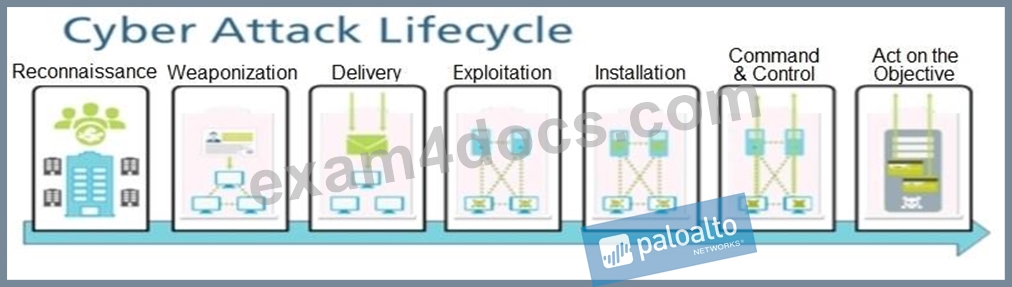
- A. Act on Objective
- B. Exploitation
- C. Reconnaissance
- D. Installation
Answer: B
NEW QUESTION # 184
Which table for NAT and NPTv6 (IPv6-to-IPv6 Network Prefix Translation) settings is available only on Panorama?
- A. NAT Policies General Tab
- B. NAT Active/Active HA Binding Tab
- C. NAT Translated Packet Tab
- D. NAT Target Tab
Answer: D
Explanation:
The NAT Target tab is a table that allows you to specify the target firewalls or device groups for each NAT policy rule on Panorama. This tab is available only on Panorama and not on individual firewalls. The NAT Target tab enables you to create a single NAT policy rulebase on Panorama and then selectively push the rules to the firewalls or device groups that require them. This reduces the complexity and duplication of managing NAT policies across multiple firewalls1. Reference: NAT Target Tab, NAT Policy Overview, NPTv6 Overview, Updated Certifications for PAN-OS 10.1.
NEW QUESTION # 185
A security administrator has configured App-ID updates to be automatically downloaded and installed. The company is currently using an application identified by App-ID as SuperApp_base.
On a content update notice, Palo Alto Networks is adding new app signatures labeled SuperApp_chat and SuperApp_download, which will be deployed in 30 days.
Based on the information, how is the SuperApp traffic affected after the 30 days have passed?
- A. All traffic matching the SuperApp_chat, and SuperApp_download is denied because it no longer matches the SuperApp-base application
- B. No impact because the apps were automatically downloaded and installed
- C. No impact because the firewall automatically adds the rules to the App-ID interface
- D. All traffic matching the SuperApp_base, SuperApp_chat, and SuperApp_download is denied until the security administrator approves the applications
Answer: A
Explanation:
Explanation
https://docs.paloaltonetworks.com/pan-os/9-0/pan-os-admin/app-id/manage-new-app-ids-introduced-in-content-r
NEW QUESTION # 186
How often does WildFire release dynamic updates?
- A. every 5 minutes
- B. every 60 minutes
- C. every 30 minutes
- D. every 15 minutes
Answer: A
Explanation:
WildFire Provides near real-time malware and antivirus signatures created as a result of the analysis done by the WildFire public cloud. WildFire signature updates are made available every five minutes. You can set the firewall to check for new updates as frequently as every minute to ensure that the firewall retrieves the latest WildFire signatures within a minute of availability.
Without the WildFire subscription, you must wait at least 24 hours for the signatures to be provided in the Antivirus update.
https://docs.paloaltonetworks.com/pan-os/9-1/pan-os-admin/software-and-content- updates/dynamic-content-updates
NEW QUESTION # 187
How often are new and modified threat signatures and modified applications signatures published?
- A. hourly
- B. monthly
- C. daily
- D. weekly
Answer: D
NEW QUESTION # 188
URL categories can be used as match criteria on which two policy types? (Choose two.)
- A. authentication
- B. decryption
C application override - C. NAT
Answer: A,B
NEW QUESTION # 189
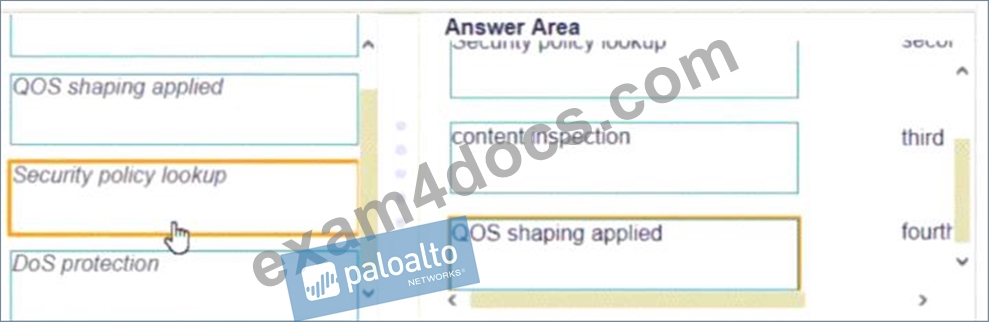
Place the following steps in the packet processing order of operations from first to last.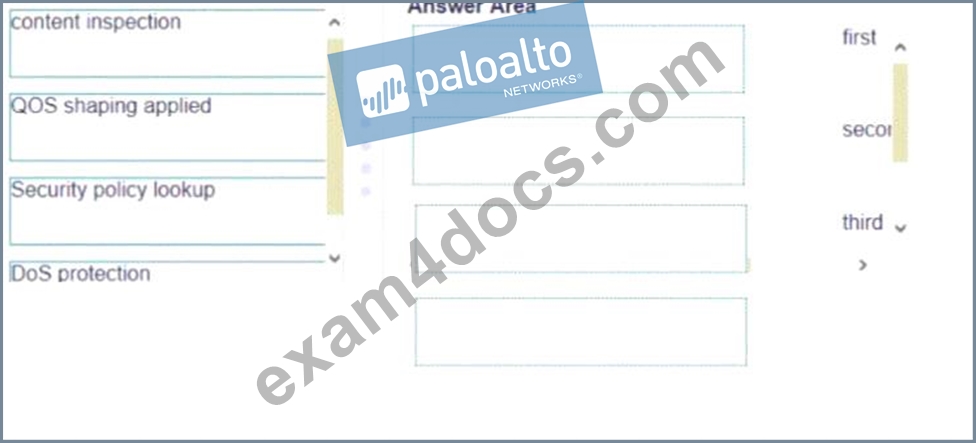
Answer:
Explanation: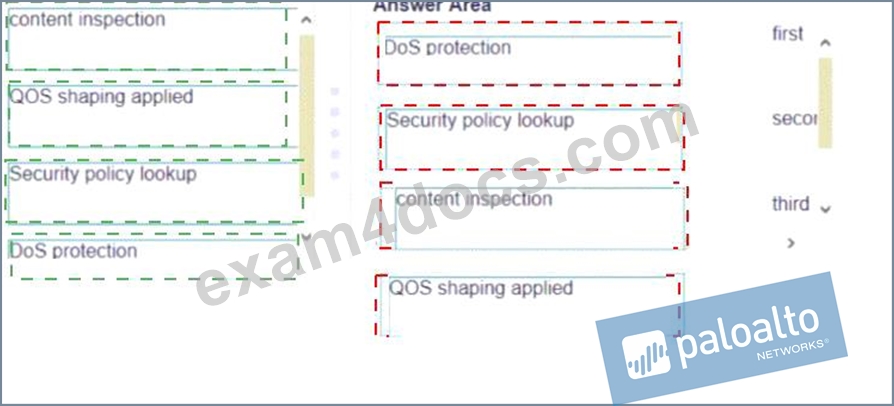
NEW QUESTION # 190
Based on the screenshot what is the purpose of the group in User labelled ''it"?
- A. Allows users to access IT applications on all ports
- B. Allows "any" users to access servers in the DMZ zone
- C. Allows users in group "it" to access IT applications
- D. Allows users in group "DMZ" lo access IT applications
Answer: C
NEW QUESTION # 191
Choose the option that correctly completes this statement. A Security Profile can block or allow traffic ____________.
- A. after it is matched by a security policy rule that allows traffic.
- B. before it is matched to a Security policy rule.
- C. on either the data place or the management plane.
- D. after it is matched by a security policy rule that allows or blocks traffic.
Answer: A
Explanation:
Explanation/Reference:
Reference:
https://docs.paloaltonetworks.com/pan-os/9-0/pan-os-admin/policy/security-policy.html
NEW QUESTION # 192 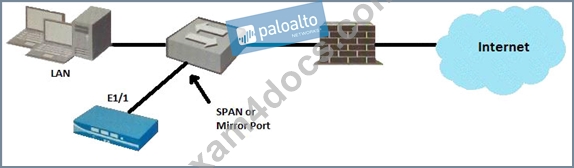
Given the topology, which zone type should interface E1/1 be configured with?
- A. Tunnel
- B. Virtual Wire
- C. Tap
- D. Layer3
Answer: C
NEW QUESTION # 193
Match the network device with the correct User-ID technology.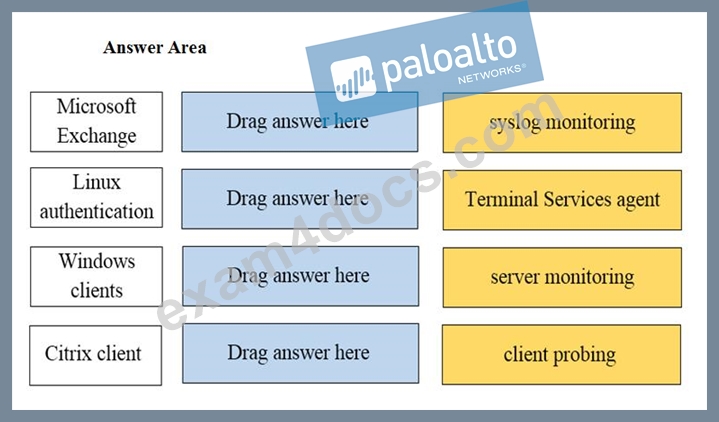
Answer:
Explanation: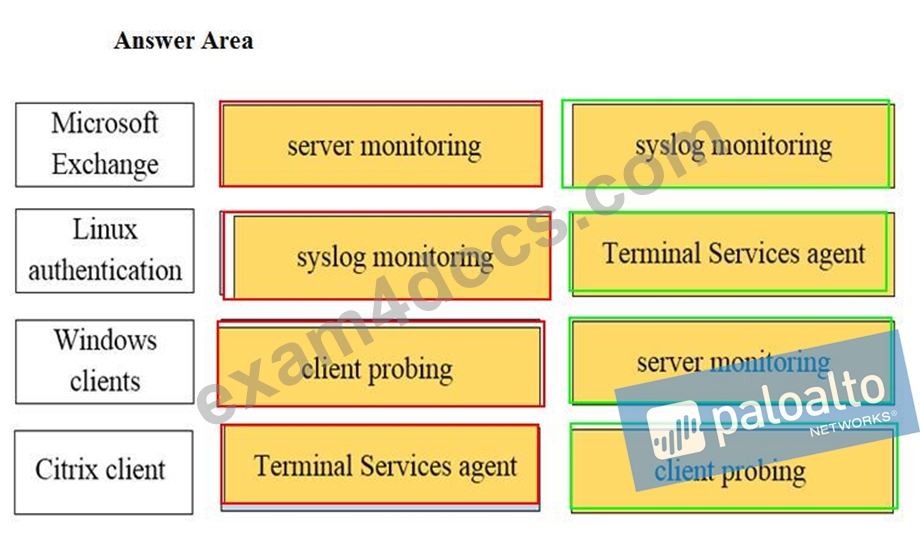
NEW QUESTION # 194
An administrator is creating a Security policy rule and sees that the destination zone is grayed out.
While creating the rule, which option was selected to cause this?
- A. Interzone
- B. Source zone
- C. Intrazone
- D. Universal (default)
Answer: C
Explanation:
In Intrazone security rules, no destination zone can be specified.
NEW QUESTION # 195
How are service routes used in PAN-OS?
- A. For routing, because they are the shortest path selected by the BGP routing protocol
- B. By the OSPF protocol, as part of Dijkstra's algorithm, to give access to the various services offered in the network
- C. To statically route subnets so they are joinable from, and have access to, the Palo Alto Networks external services
- D. To route management plane services through data interfaces rather than the management interface
Answer: D
Explanation:
Service routes are a feature of PAN-OS that allows the administrator to customize the interface that the firewall uses to send requests to external services, such as DNS, email, Palo Alto Networks updates, User-ID agent, syslog, Panorama, dynamic updates, URL updates, licenses, and AutoFocus1.
By default, the firewall uses the management interface for all service routes, unless the packet destination IP address matches the configured destination service route, in which case the source IP address is set to the source address configured for the destination1.
However, in some scenarios, the administrator may want to use a different interface for service routes, such as when the management interface does not have public internet access, or when the administrator wants to isolate or monitor the traffic for certain services23.
To configure service routes, the administrator can select Device > Setup > Services > Service Route Configuration and customize each service with a source interface and a source address. The administrator can also configure destination service routes to specify a destination IP address and a gateway for each service1.
Service routes are not related to routing protocols such as OSPF or BGP, which are used to exchange routing information between routers and determine the best path to reach a network destination. Service routes are only used to change the interface that the firewall uses to communicate with external services.
Therefore, service routes are used to route management plane services through data interfaces rather than the management interface.
References:
1: Configure Service Routes - Palo Alto Networks 2: Setting a Service Route for Services to Use a Dataplane's Interface - Palo Alto Networks 3: How to Perform Updates when Management Interface does not have Public Internet Access - Palo Alto Networks
NEW QUESTION # 196
Which path in PAN-OS 10.0 displays the list of port-based security policy rules?
- A. Policies> Security> Rule Usage> No App Specified
- B. Policies> Security> Rule Usage> Port only specified
- C. Policies> Security> Rule Usage> Unused Apps
- D. Policies> Security> Rule Usage> Port-based Rules
Answer: A
Explanation:
https://docs.paloaltonetworks.com/pan-os/9-0/pan-os-admin/app-id/security-policy-rule-optimization/migrate-port-based-to-app-id-based-security-policy-rules.html
NEW QUESTION # 197
Which feature must be configured to enable a data plane interface to submit DNS queries originated from the firewall on behalf of the control plane?
- A. Service route
- B. Virtual router
- C. Admin role profile
- D. DNS proxy
Answer: A
Explanation:
By default, the firewall uses the management (MGT) interface to access external services, such as DNS servers, external authentication servers, Palo Alto Netw orks services such as soft ware, URL updates, licenses, and AutoFocus. An alternative to using the MGT interface is configuring a data port (a standard interface) to access these services. The path from the interface to th e service on a server is aservice route. [Palo Alto Networks] PAN-OS 10 -> Device -> Setup -> Services -> Service Features -> Service Route Configuration
NEW QUESTION # 198
For the firewall to use Active Directory to authenticate users, which Server Profile is required in the Authentication Profile?
- A. TACACS+
- B. RADIUS
- C. LDAP
- D. SAML
Answer: C
Explanation:
https://docs.paloaltonetworks.com/pan-os/8-1/pan-os-admin/authentication/configure-an-authentication-profile-and-sequence
NEW QUESTION # 199
The NetSec Manager asked to create a new EMEA Regional Panorama Administrator profile with customized privileges. In particular, the new EMEA Regional Panorama Administrator should be able to:
- Access only EMEA-Regional device groups with read-only privileges
- Access only EMEA-Regional templates with read-only privileges
What is the correct configuration for the new EMEA Regional Panorama Administrator profile?
- A. Administrator Type = Device Group and Template Admin
Admin Role = EMEA_Regional_Admin_read_only
Access Domain = EMEA-Regional - B. Administrator Type = Dynamic -
Admin Role = Superuser (read-only) - C. Administrator Type = Dynamic -
Admin Role = Panorama Administrator - D. Administrator Type = Custom Panorama Admin
Profile = EMEA Regional Admin_read_only
Answer: A
NEW QUESTION # 200
When creating a Panorama administrator type of Device Group and Template Admin, which two things must you create first? (Choose two.)
- A. access domain
- B. server profile
- C. admin rote
- D. password profile
Answer: B,C
NEW QUESTION # 201
Which two configuration settings shown are not the default? (Choose two.)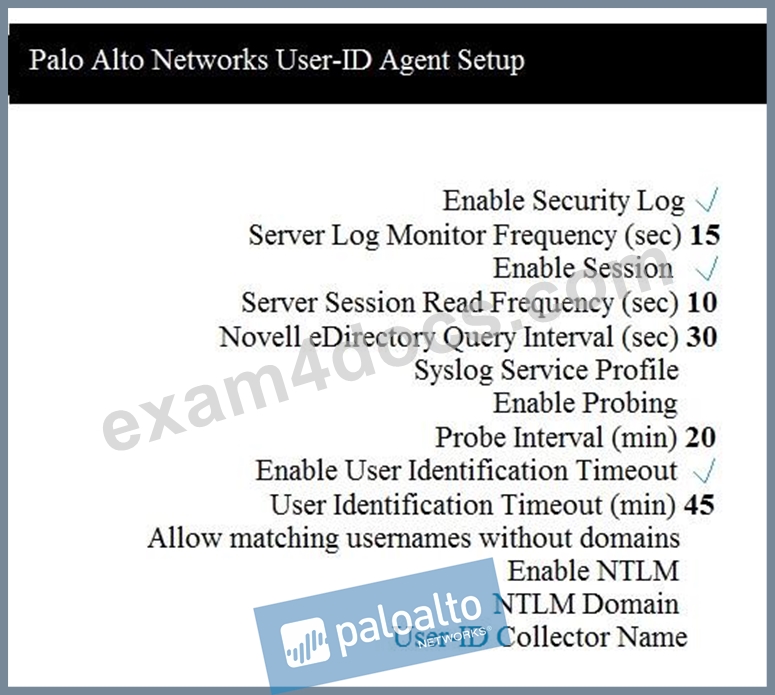
- A. Enable Security Log
- B. Enable Probing
- C. Server Log Monitor Frequency (sec)
- D. Enable Session
Answer: C,D
Explanation:
https://docs.paloaltonetworks.com/pan-os/8-0/pan-os-web-interface-help/user-identification/device-user-identification-user-mapping/enable-server-monitoring
NEW QUESTION # 202
Drag and Drop Question
Match the Cyber-Attack Lifecycle stage to its correct description.
Select and Place: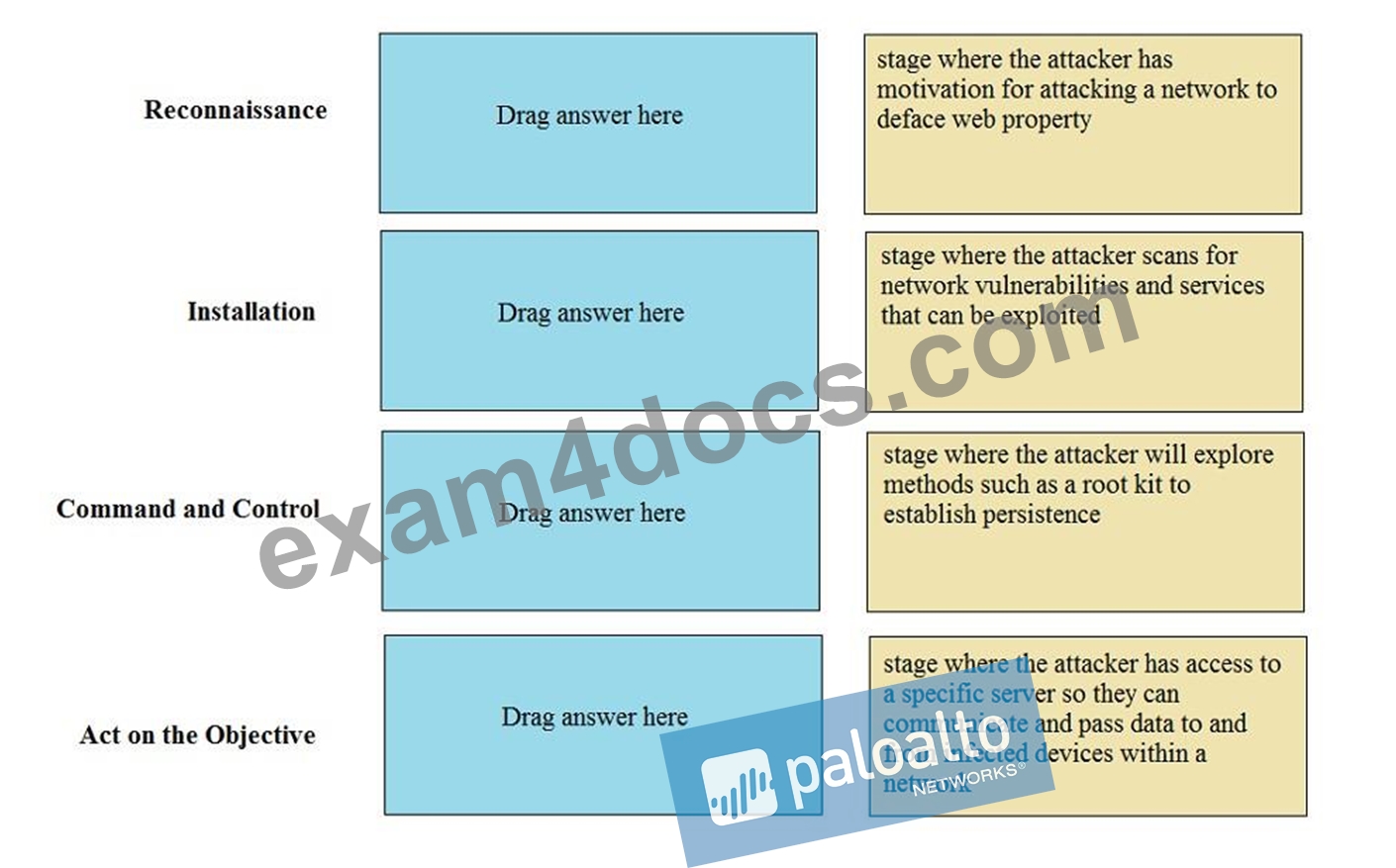
Answer:
Explanation: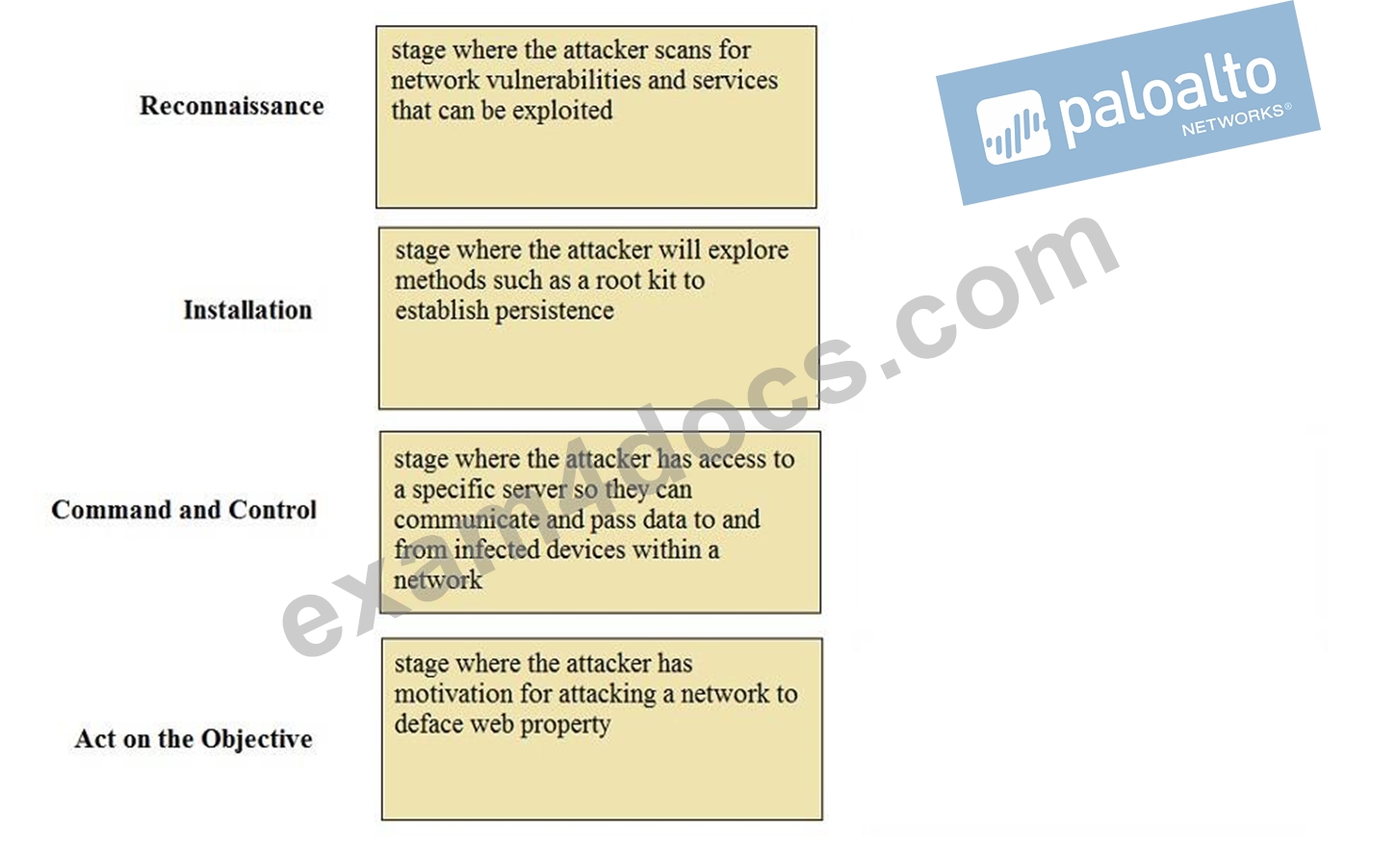
NEW QUESTION # 203
Given the topology, which zone type should interface E1/1 be configured with?
- A. Tunnel
- B. Virtual Wire
- C. Tap
- D. Layer3
Answer: C
NEW QUESTION # 204
What in the minimum frequency for which you can configure the firewall too check for new wildfire antivirus signatures?
- A. every 24 hours
- B. every 1 minute
- C. every 5 minutes
- D. every 30 minutes
Answer: B
Explanation:
NEW QUESTION # 205
Which User-ID mapping method should be used for an environment with clients that do not authenticate to Windows Active Directory?
- A. passive server monitoring using a PAN-OS integrated User-ID agent
- B. passive server monitoring using the Windows-based agent
- C. Captive Portal
- D. Windows session monitoring via a domain controller
Answer: C
Explanation:
https://docs.paloaltonetworks.com/pan-os/9-0/pan-os-admin/user-id/map-ip-addresses-to-users/map-ip-addresse
NEW QUESTION # 206
......
The PCNSA certification is a valuable credential for professionals who work with Palo Alto Networks products. Palo Alto Networks Certified Network Security Administrator certification demonstrates an individual's commitment to their career and their expertise in network security administration. It is also a valuable asset for organizations that deploy Palo Alto Networks products, as it ensures that their network security administrators have the necessary knowledge and skills to effectively manage their network infrastructure.
Get Ready to Pass the PCNSA exam Right Now Using Our Paloalto Network Security Administrator Exam Package: https://braindumps.exam4docs.com/PCNSA-study-questions.html
