

100% PASS RATE Docker Certified Associate DCA Certified Exam DUMP with 169 Questions
Updates For the Latest DCA Free Exam Study Guide!
Docker Certified Associate (DCA) Certification Exam is a globally recognized certification exam designed to measure an individual's proficiency in Docker technologies and practices. DCA exam is intended for IT professionals with a strong background in containerization and Docker who are seeking to validate their skills and knowledge in this field. Successful completion of the DCA exam will certify that an individual has a deep understanding of Docker technologies and can apply them effectively in real-world scenarios.
Docker DCA certification exam consists of 55 multiple-choice questions, and the candidate has 90 minutes to complete the exam. DCA exam covers various topics, including Docker architecture, image creation, networking, security, and troubleshooting. DCA exam is conducted online, and the candidate needs to have a stable internet connection and a webcam.
NEW QUESTION # 67
Seven managers are in a swarm cluster.
Is this how should they be distributed across three datacenters or availability zones?
Solution: 3-2-2
- A. Yes
- B. No
Answer: A
NEW QUESTION # 68
Are these conditions sufficient for Kubernetes to dynamically provision a persistentVolume, assuming there are no limitations on the amount and type of available external storage?
Solution: A default provisioner is specified, and subsequently a persistentVolumeClaim is created.
- A. Yes
- B. No
Answer: B
Explanation:
Explanation
= The conditions are not sufficient for Kubernetes to dynamically provision a persistentVolume, because they are missing a StorageClass object. A StorageClass object defines which provisioner should be used and what parameters should be passed to that provisioner when dynamic provisioning is invoked. A persistentVolumeClaim must specify the name of a StorageClass in its storageClassName field to request a dynamically provisioned persistentVolume. Without a StorageClass, Kubernetes cannot determine how to provision the storage for the claim. References:
* Dynamic Volume Provisioning | Kubernetes
* Persistent volumes and dynamic provisioning | Google Kubernetes Engine ...
* Dynamic Provisioning and Storage Classes in Kubernetes or Dynamic Provisioning and Storage Classes in Kubernetes
NEW QUESTION # 69
Will this command ensure that overlay traffic between service tasks is encrypted?
Solution: docker service create --network --encrypted
- A. Yes
- B. No
Answer: B
Explanation:
Explanation
This command will not ensure that overlay traffic between service tasks is encrypted, because it uses an invalid option for enabling encryption and an incomplete option for specifying the network. According to the official documentation, there is no such option as --encrypted for the docker service create command. The correct option to use is --network <network-name> where <network-name> is an existing overlay network that was created with encryption enabled.
References: https://docs.docker.com/network/drivers/overlay/#encryption
https://docs.docker.com/engine/reference/commandline/service_create/
NEW QUESTION # 70
Is this an advantage of multi-stage builds?
Solution: faster image builds by allowing parallel execution of Docker builds
- A. Yes
- B. No
Answer: B
Explanation:
Explanation
= Simultaneously creating and tagging multiple images is not an advantage of multi-stage builds. Multi-stage builds are a feature that allows you to use multiple FROM statements in your Dockerfile, each starting a new stage of the build1. You can selectively copy artifacts from one stage to another, leaving behind everything you don't want in the final image. This helps you to optimize the size and security of your images, as well as to simplify your build process12. However, multi-stage builds do not create or tag multiple images at once. Each Dockerfile produces one final image, which is the result of the last stage in the Dockerfile1. If you want to create and tag multiple images from a single Dockerfile, you need to use the --target option with the docker build command, and specify the name of the stage you want to build and tag3. References:
* Multi-stage builds | Docker Docs
* What Are Multi-Stage Docker Builds? - How-To Geek
* Stop at a specific build stage | Docker Docs
NEW QUESTION # 71
Will this command list all nodes in a swarm cluster from the command line?
Solution. 'docker inspect nodes
- A. Yes
- B. No
Answer: B
Explanation:
Explanation
= The command docker inspect nodes will not list all nodes in a swarm cluster from the command line. This command is invalid, as docker inspect requires one or more object names or IDs as arguments1. To list all nodes in a swarm cluster, you need to use the docker node ls command from a manager node2. This command will display the ID, hostname, status, availability, manager status, and engine version of each node in the swarm2. You can also use the -f or --filter flag to filter the nodes by various criteria, such as role, label, or name2. References:
* 1: docker inspect | Docker Docs
* 2: docker node ls | Docker Docs
NEW QUESTION # 72
Is this an advantage of multi-stage builds?
Solution: simultaneously creates and tags multiple images
- A. Yes
- B. No
Answer: B
NEW QUESTION # 73
When seven managers are in a swarm cluster how would they be distributed across three datacenters or availability zones?
- A. 4-2-1
- B. 5-1-1
- C. 3-2-2
- D. 3-3-1
Answer: A
NEW QUESTION # 74
A company's security policy specifies that development and production containers must run on separate nodes in a given Swarm cluster.
Can this be used to schedule containers to meet the security policy requirements?
Solution: label contraints
- A. Yes
- B. No
Answer: A
Explanation:
Explanation
Label constraints can be used to schedule containers to meet the security policy requirements, because label constraints allow you to specify which nodes a service can run on based on node labels. According to the official documentation, label constraints are used to filter nodes based on their role, availability, or any other criteria.
References: https://docs.docker.com/engine/swarm/services/#specify-service-constraints
NEW QUESTION # 75
Your organization has a centralized logging solution, such as Splunk.
Will this configure a Docker container to export container logs to the logging solution?
Solution: docker logs <container-id>
- A. Yes
- B. No
Answer: B
Explanation:
Explanation
Using docker logs <container-id> does not configure a Docker container to export container logs to the logging solution. The docker logs command shows information logged by a running container, such as standard output and standard error streams. It does not send or export container logs to any external service.
References: https://docs.docker.com/engine/reference/commandline/logs/,
https://docs.docker.com/config/containers/logging/
NEW QUESTION # 76
You want to provide a configuration file to a container at runtime. Does this set of Kubernetes tools and steps accomplish this?
Solution: Turn the configuration file into a configMap object, use it to populate a volume associated with the pod, and mount that file from the volume to the appropriate container and path.
- A. Yes
- B. No
Answer: B
Explanation:
Explanation
= Mounting the configuration file directly into the appropriate pod and container using the
.spec.containers.configMounts key is not a valid way to provide a configuration file to a container at runtime. The .spec.containers.configMounts key does not exist in the Kubernetes API1. The correct way to provide a configuration file to a container at runtime is to use a ConfigMap2. A ConfigMap is a Kubernetes object that stores configuration data as key-value pairs. You can create a ConfigMap from a file, and then mount the ConfigMap as a volume into the pod and container. The configuration file will be available as a file in the specified mount path3. Alternatively, you can also use environment variables to pass configuration data to a container from a ConfigMap4. References:
* PodSpec v1 core
* Configure a Pod to Use a ConfigMap
* Populate a Volume with data stored in a ConfigMap
* Define Container Environment Variables Using ConfigMap Data
NEW QUESTION # 77
Is this the purpose of Docker Content Trust?
Solution: Enable mutual TLS between the Docker client and server.
- A. Yes
- B. No
Answer: B
Explanation:
Explanation
Enabling mutual TLS between the Docker client and server is not the purpose of Docker Content Trust.
According to the official documentation, the purpose of Docker Content Trust is to verify the integrity and publisher of all data received from a registry over any channel.
References: https://docs.docker.com/engine/security/trust/content_trust/
NEW QUESTION # 78
The following Docker Compose file is deployed as a stack: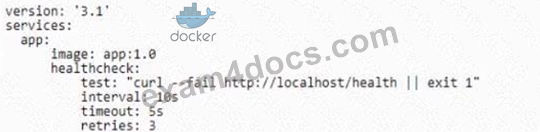
Is this statement correct about this health check definition?
Solution: Health checks test for app health ten seconds apart. Three failed health checks transition the container into "unhealthy" status.
- A. Yes
- B. No
Answer: A
NEW QUESTION # 79
Will a DTR security scan detect this?
Solution.private keys copied to the image
- A. Yes
- B. No
Answer: A
Explanation:
Explanation
= A DTR security scan will detect private keys copied to the image. DTR security scan is a feature of Docker Trusted Registry (DTR) that scans images to detect any security vulnerability1. DTR security scan uses the open source tool SecretScanner2 to find unprotected secrets in container images or file systems. SecretScanner can match the contents of images against a database of approximately 140 secret types, including private keys3. Therefore, if an image contains private keys, DTR security scan will report them as potential secrets and alert the user to remove them from the image. References:
* Scan images for vulnerabilities | Docker Docs
* GitHub - deepfence/SecretScanner: :unlock: Find secrets and passwords ...
* SecretScanner/deepfence_secret_scanner.py at main deepfence/SecretScanner
NEW QUESTION # 80
In the context of a swarm mode cluster, does this describe a node?
Solution: a physical machine participating in the swarm
- A. Yes
- B. No
Answer: A
Explanation:
Explanation
A node is a physical or virtual machine running Docker Engine in swarm mode1. A node can be either a manager or a worker, depending on its role in the cluster1. A physical machine participating in the swarm is a node, regardless of its role or availability2. References:
* How nodes work | Docker Docs
* Manage nodes in a swarm | Docker Docs
NEW QUESTION # 81
Is this statement correct?
Solution: A Dockerfile stores the Docker daemon's configuration options.
- A. Yes
- B. No
Answer: B
Explanation:
Explanation
The statement is not correct. A Dockerfile does not store the Docker daemon's configuration options. A Dockerfile is a text document that contains all the commands a user could call on the command line to assemble an image1. A Dockerfile is used to build images, not to configure the Docker daemon. The Docker daemon's configuration options are stored in a JSON file, which is usually located at /etc/docker/daemon.json on Linux systems, or C:\ProgramData\docker\config\daemon.json on Windows2. The JSON file allows you to customize the Docker daemon's behavior, such as enabling debug mode, setting TLS certificates, or changing the data directory2. References: Dockerfile reference), Docker daemon configuration overview)
NEW QUESTION # 82
Will this command mount the host's '/data' directory to the ubuntu container in read-only mode?
Solution: 'docker run -v /data:/mydata --mode readonly ubuntu'
- A. Yes
- B. No
Answer: B
Explanation:
Explanation
This command will not mount the host's '/data' directory to the ubuntu container in read-only mode, because it has an incorrect option for making the volume read-only. According to the official documentation, the correct command should be:
docker run -v /data:/mydata:ro ubuntu
The incorrect option is:
The --mode flag does not exist and should be replaced by a :ro suffix to make the volume read-only.
References: https://docs.docker.com/engine/reference/commandline/run/#mount-volume-v-read-only
https://docs.docker.com/storage/volumes/#use-a-read-only-volume
NEW QUESTION # 83
Will a DTR security scan detect this?
Solution: licenses for known third party binary components
- A. Yes
- B. No
Answer: A
Explanation:
Explanation
A DTR security scan will detect licenses for known third party binary components. This is because DTR security scan uses a database of vulnerabilities and licenses that is updated regularly from Docker Server1. DTR security scan can identify the components and versions of the software packages that are present in the image layers, and report any known vulnerabilities or licenses associated with them2. This can help users to comply with the licensing requirements and avoid potential legal issues3. References:
* Set up vulnerability scans | Docker Docs
* Scan images for vulnerabilities | Docker Docs
* Container Security 101 - Scanning images for Vulnerabilities
NEW QUESTION # 84
You are troubleshooting a Kubernetes deployment called api, and want to see the events table for this object.
Does this command display it?
Solution: kubectl logs deployment api
- A. Yes
- B. No
Answer: B
Explanation:
Explanation
= The command kubectl logs deployment api does not display the events table for the deployment object, but rather the logs of the pods that belong to the deployment. To see the events table, you need to use the command kubectl describe deployment api, which shows the details of the deployment, including the events1. References: Kubernetes Documentation, Practice Questions for Docker Certified Associate (DCA) Exam
NEW QUESTION # 85
A server is running low on disk space. What command can be used to check the disk usage of images,
containers, and volumes for Docker engine?
- A. 'docker system prune'
- B. 'docker system ps'
- C. 'docker system df'
- D. 'docker system free'
Answer: C
NEW QUESTION # 86
You created a new service named 'http' and discover it is not registering as healthy. Will this command enable you to view the list of historical tasks for this service?
Solution:'docker inspect http'
- A. Yes
- B. No
Answer: B
Explanation:
Explanation
= The 'docker inspect' command returns low-level information on Docker objects, such as containers, images, networks, etc1 It does not show the list of historical tasks for a service. To view the list of tasks for a service, you need to use the 'docker service ps' command 2. For example, to see the tasks for the 'http' service, you would run 'docker service ps http'. This would show the ID, name, image, node, desired state, current state, and error of each task 2. References: Docker inspect | Docker Docs, Docker service ps | Docker Docs
NEW QUESTION # 87
Seven managers are in a swarm cluster.
Is this how should they be distributed across three datacenters or availability zones?
Solution: 3-3-1
- A. Yes
- B. No
Answer: B
Explanation:
Explanation
This is not how they should be distributed across three datacenters or availability zones, because having one manager in one datacenter or availability zone creates a single point of failure and reduces the fault tolerance of the swarm. According to the official documentation, managers should be distributed evenly across datacenters or availability zones to ensure that the swarm can survive the loss of any one datacenter or availability zone.
References: https://docs.docker.com/engine/swarm/admin_guide/#add-manager-nodes-for-fault-tolerance
NEW QUESTION # 88
......
Best DCA Exam Preparation Material with New Dumps Questions https://braindumps.exam4docs.com/DCA-study-questions.html
