

[Feb-2026] 100% Actual 300-730 dumps Q&As with Explanations Verified & Correct Answers
300-730 Dumps with Free 365 Days Update Fast Exam Updates
The associate exam 300-730 or Implementing Secure Solutions with Virtual Private Networks is linked to the CCNP Security certificate. It helps candidates to figure out how well they can implement secure remote communications with VPN solutions. Some of the areas tested in this exam include security for communication, architecture, and troubleshooting.
Cisco 300-730 exam is designed to test the knowledge and skills of IT professionals in implementing secure solutions with virtual private networks. Implementing Secure Solutions with Virtual Private Networks certification exam is ideal for network engineers, security administrators, and system administrators who are responsible for designing, implementing, and maintaining secure virtual networks. 300-730 exam covers a wide range of topics, including VPN technologies, secure remote access, AAA (Authentication, Authorization, and Accounting), and endpoint security.
NEW QUESTION # 21
Drag and drop the correct commands from the night onto the blanks within the code on the left to implement a design that allow for dynamic spoke-to-spoke communication. Not all comments are used.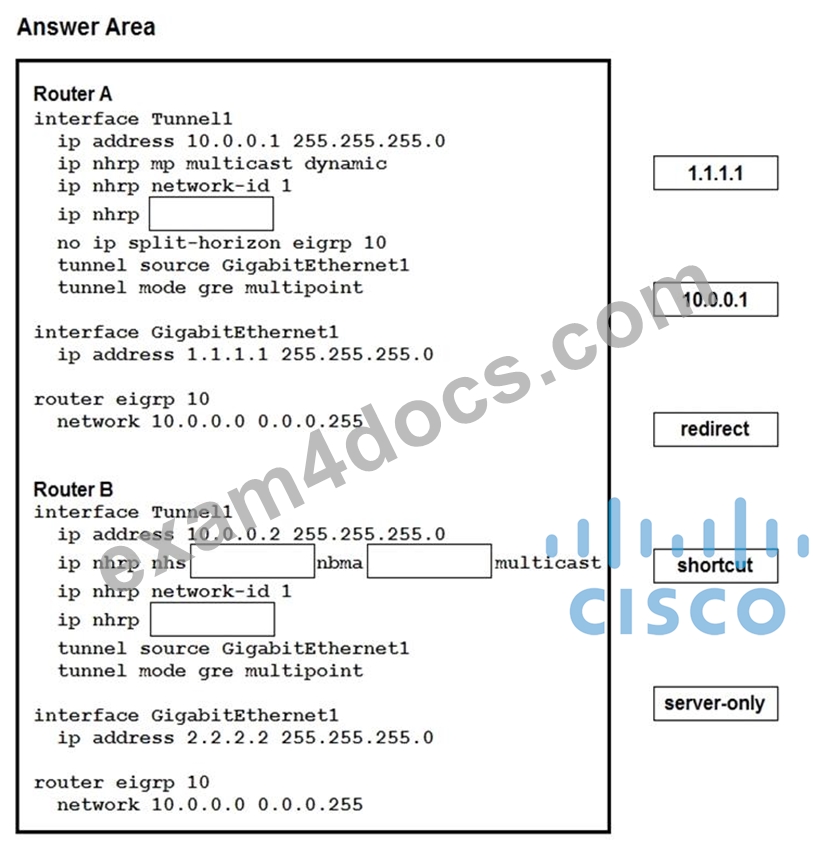
Answer:
Explanation: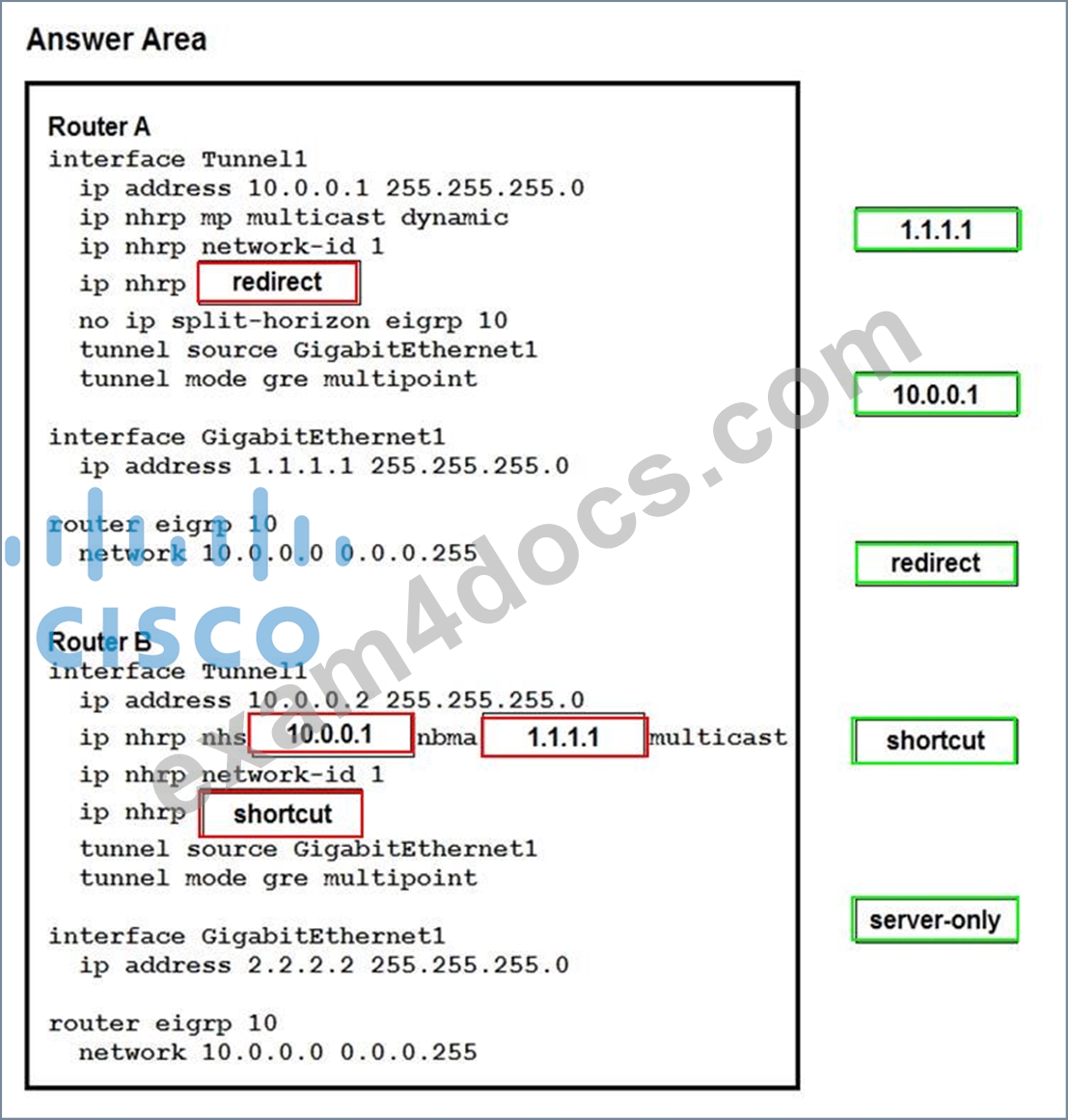
NEW QUESTION # 22
A router is being configured for IKEv2 AnyConnect using AnyConnect-EAP. How would the administrator separate profiles for administrators and employees so that authorization differs when they connect?
- A. Define group aliases on the headend and have the user pick the appropriate alias when they connect
- B. Define group-urls on the headend and create two XML profiles to match the administrator and user group urls
- C. Create a certificate map and match on the appropriate certificate fields
- D. Define key-ids on the headend and create two XML profiles to match the administrator and user key-ids.
Answer: A
Explanation:
When configuring IKEv2 AnyConnect using AnyConnect-EAP, the administrator can define group aliases on the headend and have the user pick the appropriate alias when they connect. This allows the administrator to separate profiles for administrators and employees so that authorization differs when they connect.
NEW QUESTION # 23
A network engineer has almost finished setting up a clientless VPN that allows remote users to access internal HTTP servers. Users must enter their username and password twice: once on the clientless VPN web portal and again to log in to internal HTTP servers. The Cisco ASA and the HTTP servers use the same Active Directory server to authenticate users. Which next step must be taken to allow users to enter their password only once?
- A. Create smart tunnels for the HTTP servers.
- B. Set up the Cisco ASA to authenticate users via a SAML 2.0 IDP.
- C. Use LDAPS and add password management to the clientless tunnel group.
- D. Configure auto-sign-on using NTLM authentication.
Answer: D
NEW QUESTION # 24
Refer to the exhibit.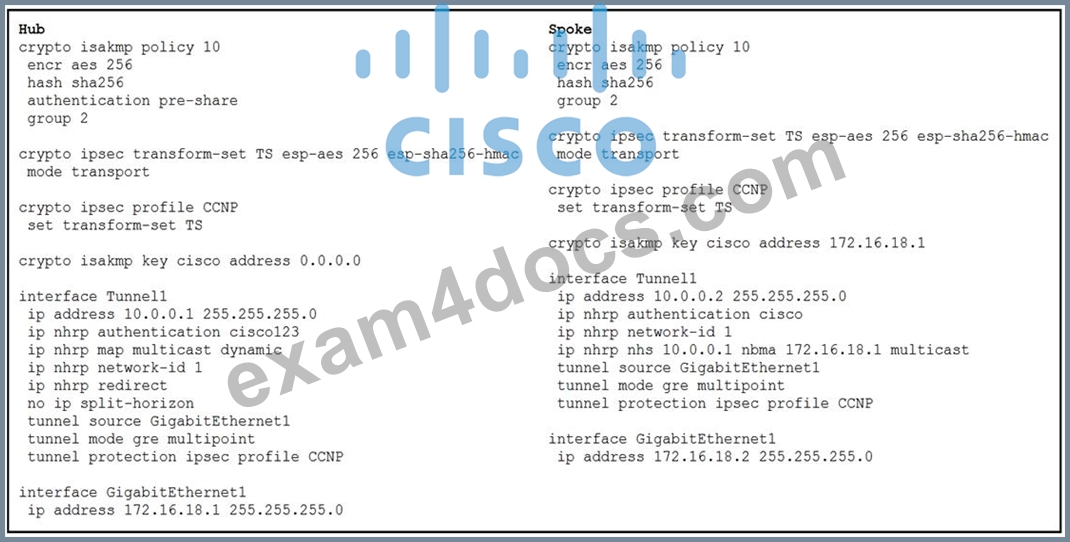
The DMVPN spoke is not establishing a session with the hub. Which two actions resolve this issue? (Choose two.)
- A. Change the nhrp authentication key on the spoke to cisco123.
- B. Change the ISAKMP key address on the spoke to 0.0.0.0.
- C. Change the spoke nhs to 172.16.18.1 and the nbma to 10.0.0.1.
- D. Change the transform set to mode tunnel.
- E. Change the ISAKMP policy authentication on the spoke to pre-shared.
Answer: A,E
NEW QUESTION # 25
Refer to the exhibit.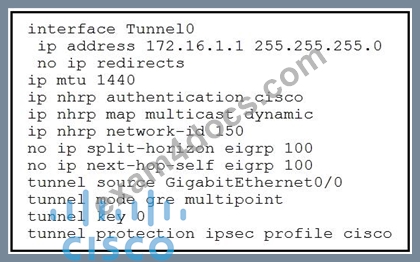
Which two conclusions should be drawn from the DMVPN phase 2 configuration? (Choose two.)
- A. EIGRP neighbor adjacency will fail.
- B. EIGRP route redistribution is not allowed.
- C. EIGRP is used as the dynamic routing protocol.
- D. Spoke-to-spoke communication is allowed.
- E. Next-hop-self is required.
Answer: C,D
NEW QUESTION # 26
A network engineer must configure the Cisco ASA so that Cisco AnyConnect clients establishing an SSL VPN connection create an additional tunnel for real-time traffic that is sensitive to packet delays. If this additional tunnel experiences any issues, it must fall back to a TLS connection.
Which two Cisco AnyConnect features must be configured to accomplish this task? (Choose two.)
- A. DSCP Preservation
- B. SSL Rekey
- C. OMTU
- D. DPD
- E. DTLS
Answer: D,E
Explanation:
Configure Dead Peer Detection Dead Peer Detection (DPD) ensures that the ASA (gateway) or the client can quickly detect a condition where the peer is not responding, and the connection has failed. To enable dead peer detection (DPD) and set the frequency with which either the AnyConnect client or the ASA gateway performs DPD, do the following: Before you begin This feature applies to connectivity between the ASA gateway and the AnyConnect SSL VPN Client only. It does not work with IPsec since DPD is based on the standards implementation that does not allow padding, and CLientless SSL VPN is not supported. If you enable DTLS, enable Dead Peer Detection (DPD) also. DPD enables a failed DTLS connection to fallback to TLS. Otherwise, the connection terminates.
https://www.cisco.com/c/en/us/td/docs/security/asa/asa96/configuration/vpn/asa-96-vpn- config/vpn-anyconnect.html
NEW QUESTION # 27
Refer to the exhibit.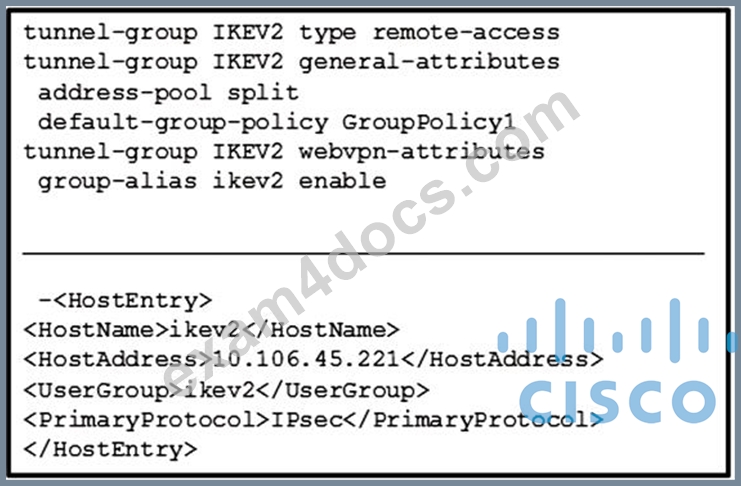
The customer can establish a Cisco AnyConnect connection without using an XML profile. When the host "ikev2" is selected in the AnyConnect drop down, the connection fails. What is the cause of this issue?
- A. Primary protocol should be SSL.
- B. The IP address is incorrect.
- C. The HostName is incorrect.
- D. UserGroup must match connection profile.
Answer: D
Explanation:
Reference:
https://community.cisco.com/t5/security-documents/anyconnect-xml-settings/ta-p/3157891
NEW QUESTION # 28
A user is experiencing delays on audio calls over a Cisco AnyConnect VPN. Which implementation step resolves this issue?
- A. Install the Cisco AnyConnect 2.3 client for the user to download.
- B. Shorten the encryption key lifetime.
- C. Enable DTLS.
- D. Change to 3DES Encryption.
Answer: C
NEW QUESTION # 29
An administrator is setting up a VPN on an ASA for users who need to access an internal RDP server. Due to security restrictions, the Microsoft RDP client is blocked from running on client workstations via Group Policy. Which VPN feature should be implemented by the administrator to allow these users to have access to the RDP server?
- A. clientless plug-in
- B. clientless rewriter
- C. clientless proxy
- D. smart tunneling
Answer: A
NEW QUESTION # 30
Refer to the exhibit. A site-to-site tunnel between two sites is not coming up.
Based on the debugs, what is the cause of this issue?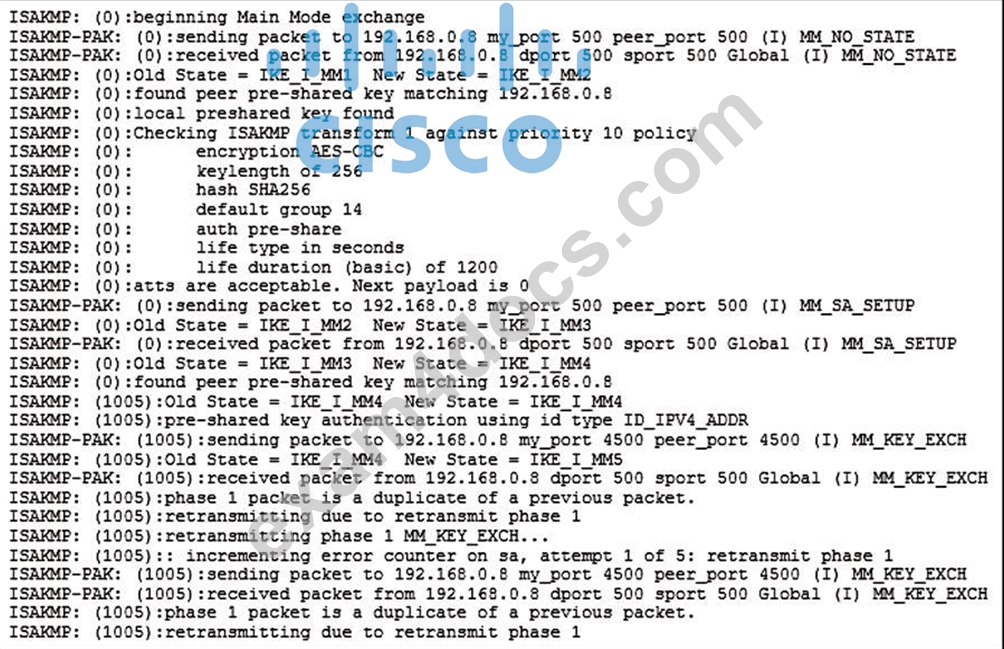
- A. An authentication failure occurs on the remote peer.
- B. An authentication failure occurs on the router.
- C. UDP 4500 traffic from the peer does not reach the router.
- D. A certificate fragmentation issue occurs between both sides.
Answer: C
NEW QUESTION # 31
Which clientless SSLVPN supported feature works when the http-only-cookie command is enabled?
- A. script browser
- B. Java plug-ins
- C. port reflector
- D. Citrix load balancer
- E. Java rewriter
Answer: B
Explanation:
The following Clientless SSL VPN features will not work when the http-only-cookie command is enabled:
* Java plug-ins
* Java rewriter
* Port forwarding
* File browser
* Sharepoint features that require desktop applications (for example, MS Office applications)
* AnyConnect Web launch
* Citrix Receiver, XenDesktop, and Xenon
* Other non-browser-based and browser plugin-based applications
NEW QUESTION # 32
Which command identifies a Cisco AnyConnect profile that was uploaded to the flash of an IOS router?
- A. webvpn import profile SSL_profile flash:simos-profile.xml
- B. anyconnect profile SSL_profile flash:simos-profile.xml
- C. svc import profile SSL_profile flash:simos-profile.xml
- D. crypto vpn anyconnect profile SSL_profile flash:simos-profile.xml
Answer: D
Explanation:
Reference:
https://www.cisco.com/c/en/us/support/docs/security/anyconnect-secure-mobility-client/200533- AnyConnect-Configure-Basic-SSLVPN-for-I.html
NEW QUESTION # 33
In a FlexVPN deployment, the spokes successfully connect to the hub, but spoke-to-spoke tunnels do not form. Which troubleshooting step solves the issue?
- A. Verify the spoke configuration to check if the NHRP redirect is enabled.
- B. Verify that the spoke receives redirect messages and sends resolution requests.
- C. Verify that the tunnel interface is contained within a VRF.
- D. Verify the hub configuration to check if the NHRP shortcut is enabled.
Answer: B
Explanation:
Reference:
On receiving the redirect, Spoke1 initiates a resolution request for Host2 over the point-to-point tunnel interface (the same interface over which it received the redirect). The resolution request traverses the routed path (Spoke1-hub-spoke2). On receiving the resolution request, Spoke2 determines that it is the exit point and needs to respond to the resolution request. https://www.cisco.com/en/US/docs/ios-xml/ios/sec_conn_ike2vpn/configuration/15-2mt/sec-flex-spoke.html
NEW QUESTION # 34
Refer to the exhibit.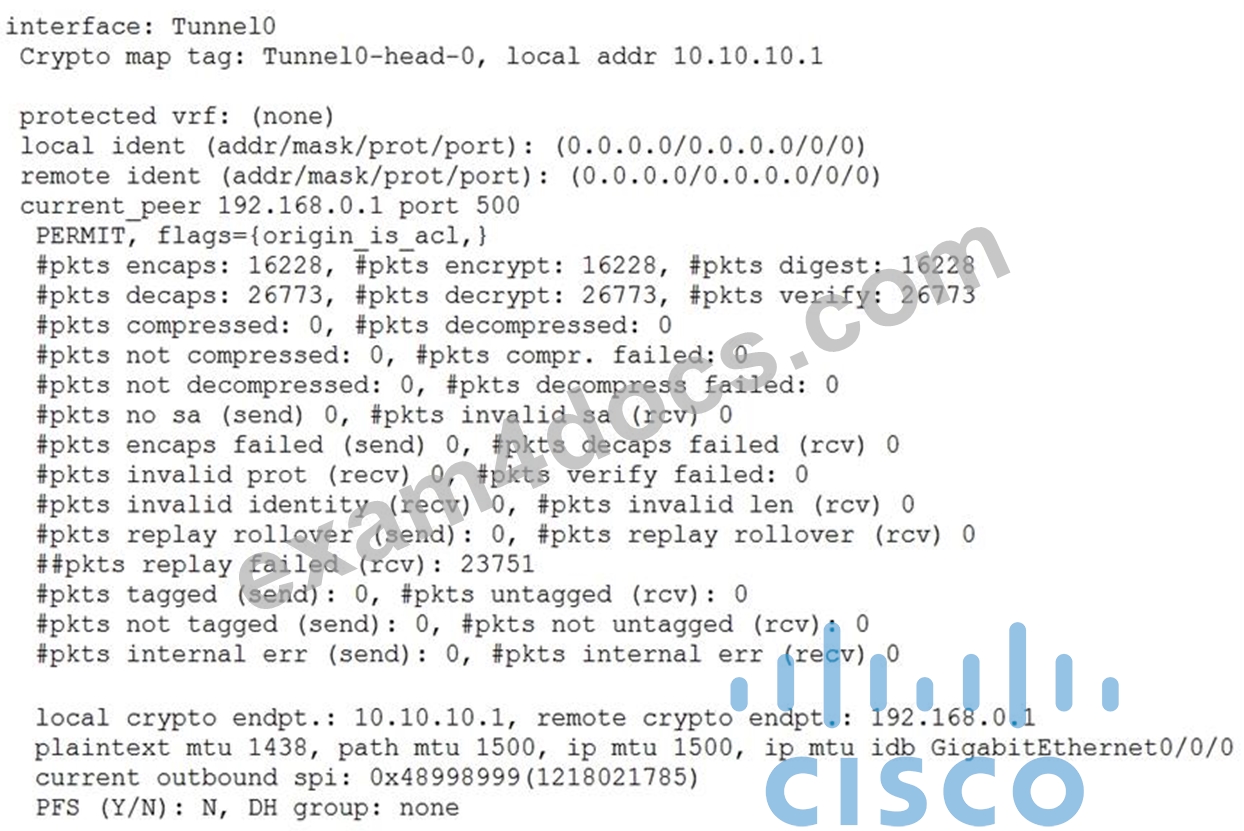
Upon setting up a tunnel between two sites, users are complaining that connections to applications over the VPN are not working consistently. The output of show crypto ipsec sa was collected on one of the VPN devices. Based on this output, what should be done to fix this issue?
- A. Lower the tunnel MTU.
- B. Make an adjustment to IPSec replay window.
- C. Specify the application networks in the remote identity.
- D. Enable perfect forward secrecy.
Answer: B
Explanation:
https://www.cisco.com/c/en/us/td/docs/ios-xml/ios/sec_conn_dplane/configuration/xe-16-8/sec-ipsec-data-plane-xe-16-8-book/sec-ipsec-antireplay.html#GUID-1FF00FBB-0746-48B2-A02A-2BB066BEDEF8
NEW QUESTION # 35
Refer to the exhibit.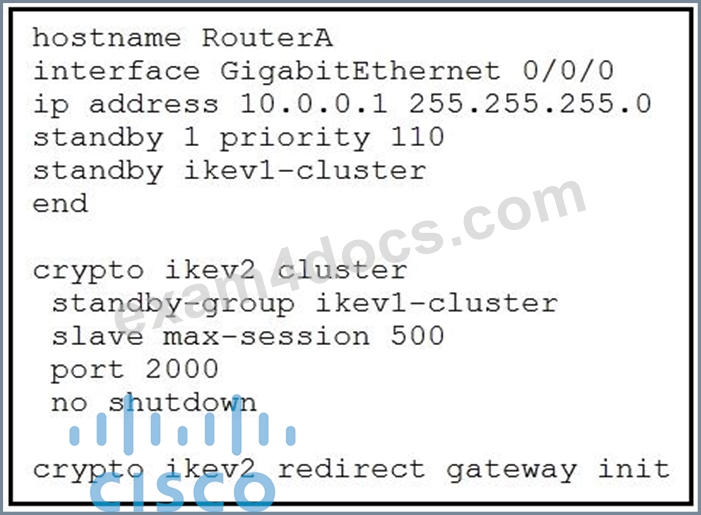
Which type of VPN implementation is displayed?
- A. IKEv2 backup gateway
- B. IKEv2 load balancer
- C. IKEv2 reconnect
- D. IKEv1 cluster
Answer: B
NEW QUESTION # 36
Which interface type must be used in an IKEv2 deployment that needs to route non-IP traffic?
- A. GRE interface
- B. dynamic virtual tunnel interface
- C. bridge virtual interface
- D. virtual tunnel interface
Answer: A
Explanation:
In an IKEv2 VPN deployment, if there is a requirement to route non-IP traffic (such as IPX, AppleTalk, or other Layer 3 protocols besides IP), a GRE (Generic Routing Encapsulation) interface must be used.
IKEv2 natively supports only IP traffic when using traditional Virtual Tunnel Interfaces (VTI) or Dynamic Virtual Tunnel Interfaces (DVTI).
However, GRE encapsulates non-IP protocols within an IP packet, allowing these protocols to be transmitted over an IPsec-protected GRE tunnel.
A typical GRE over IPsec configuration looks like this:
interface Tunnel0
tunnel source GigabitEthernet0/1
tunnel destination <remote_peer_IP>
tunnel mode gre ip
ip address 192.168.1.1 255.255.255.252
Then, IPsec is applied to protect the GRE tunnel.
NEW QUESTION # 37
Which clientless SSLVPN supported feature works when the http-only-cookie command is enabled?
- A. script browser
- B. Java rewriter -
- C. Java plug-ins
- D. port reflector
- E. Citrix load balancer
Answer: C
Explanation:
https://www.cisco.com/c/en/us/td/docs/security/asa/asa94/config-guides/asdm74/vpn/asdm-74-vpn-config/webvpn-troubleshooting.html The following Clientless SSL VPN features will not work when the http-only-cookie command is enabled:
* Java plug-ins
* Java rewriter
* Port forwarding
* File browser
* Sharepoint features that require desktop applications (for example, MS Office applications)
* AnyConnect Web launch
* Citrix Receiver, XenDesktop, and Xenon
* Other non-browser-based and browser plugin-based applications
NEW QUESTION # 38
A Cisco ASA is configured in active/standby mode. What is needed to ensure that Cisco AnyConnect users can connect after a failover event?
- A. AnyConnect images must be uploaded to both failover ASA devices.
- B. Configure a backup server in the XML profile.
- C. The vpnsession-db must be cleared manually.
- D. AnyConnect client must point to the standby IP address.
Answer: A
Explanation:
Section: Secure Communications Architectures
Explanation/Reference: https://www.cisco.com/c/en/us/td/docs/security/asa/asa90/configuration/guide/asa_90_cli_config/ ha_active_standby.html
NEW QUESTION # 39
Refer to the exhibit. Which type of VPN implementation is displayed?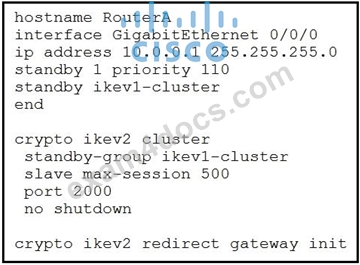
- A. IKEv2 backup gateway
- B. IKEv2 load balancer
- C. IKEv2 reconnect
- D. IKEv1 cluster
Answer: B
Explanation:
https://www.cisco.com/c/en/us/td/docs/ios-xml/ios/sec_conn_ike2vpn/configuration/xe-16-10/sec- flex-vpn-xe-16-10-book/sec-cfg-clb-supp.html
NEW QUESTION # 40
Refer to the exhibit. The network security engineer identified that the hub router cannot send traffic to the spoke router. Based on the provided output, which action resolves the issue?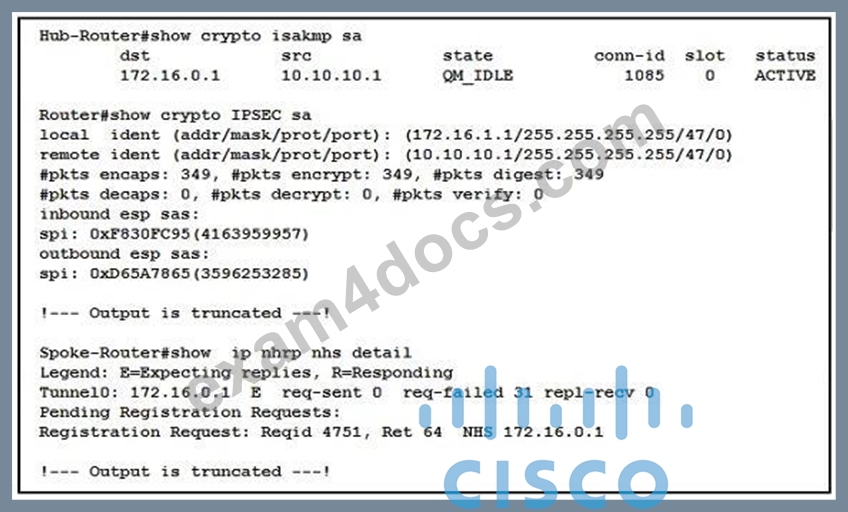
- A. Ensure the preshared key on the hub-and-spoke router matches.
- B. Correct the next hop server IP address on the spoke router.
- C. Adjust the ip nhrp network-id command on the hub router.
- D. Permit UDP ports 500 and 4500 between the hub and spoke.
Answer: B
NEW QUESTION # 41
......
Verified 300-730 dumps Q&As - 2026 Latest 300-730 Download: https://braindumps.exam4docs.com/300-730-study-questions.html
