

100% Pass Guaranteed Accurate HPE7-A07 Answers 365 Days Free Updates
HPE7-A07 DUMPS Q&As with Explanations Verified & Correct Answers
NEW QUESTION # 68
An ACME company employee complained about a recent poor-quality VoIP call while moving aroundtheir office environment HPE Aruba Networking Central reported a fair UCC score for this callwhile your VoIP engineer reported that their systems reported a MOS of 2,3. The VoIP devices are operatingover the 5GHz frequency band.
What are the possible contributing factors? (Select two.)
- A. There was localized interference at the caller's location
- B. The client roamed into an area that continuously operates Zigbee.
- C. Coverage AP deployment plans generally don't support enough cell overlap for VoIP.
- D. 802.1K is disabled in the WLAN Security settings
- E. 802.tr is enabled in the WLAN Security settings.
Answer: B,C
Explanation:
VoIP quality can be negatively impacted by insufficient cell overlap in AP deployment plans, which can cause poor handoffs between APs as a user moves around. This results in a degraded VoIP experience. Additionally, roaming into an area with continuous Zigbee operation can cause interference with the 5GHz frequency band, further contributing to poor VoIP call quality. The Zigbee communication protocol operates on the same frequency band as Wi-Fi and can introduce noise and interference, which leads to a reduced MOS score, as reported by the VoIP engineer.
NEW QUESTION # 69
A customer is evaluating device profiles on a CX 6300 switch. The test device has the following attribute: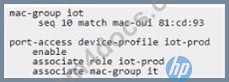
* MAC address=81:cd:93:13:ab:31
The test device needs to be assigned the "lot-prod'' role, in addition the "lot-default" role must be applied for any other device connected lo interface 1/1/1. This is a lab environment with no configuration of any external authentication server for the test.
Given the configuration example, what is required to meet this testing requirement?
- A. Enter the command "port-access fallback-role lot-default globally
- B. Enter the command "port-access onboarding-method precedence" to set device profiles with a lower precedence.
- C. Enter the command "pot-access device-profile mode block-until-profile-applied"" for interface 1/1/1.
- D. Enter the command "port-access device-profile mode block-until-profile-applied" globally.
Answer: A
Explanation:
The fallback role is used as a default role in the absence of a specified role or when an authentication server is not available. Given the scenario, where the test device with MAC address 81:cd:93:13:ab:31 needs to be assigned to "iot-prod" and other devices to "iot-default", and considering there is no external authentication server configured for the test, the appropriate action would be to set a global fallback role that applies to all devices connecting to the network. This ensures that any device that does not match the specific device profile will inherit the "iot-default" role. Since the configuration for a specific MAC address (81:cd:93:xx:xx:xx) to associate with the "iot-prod" role is already in place, setting the fallback role globally accommodates the requirement for other devices.
NEW QUESTION # 70
A customer is reviewing HPE Aruba Networking Central's Client Insights and notices that several wireless clients are not displaying flow attributes and network activity in the profile tab. This deployment is using AOS-10 mobility gateways.
What are the possible reasons why this data is not visible in HPE Aruba Networking Central? (Select two)
- A. The wireless client VLANs on the gateways are marked as untrusted
- B. The wireless client VLANs on the gateways are marked as trusted
- C. The client's SSID is configured as mixed mode, and the clients experiencing the issue are tunneled out of the APs
- D. The client's SSID is configured as mixed mode, and the clients experiencing the issue are bridged out of the APs
- E. The client's SSID is configured as bridged
Answer: D,E
Explanation:
* Why C and D are correct (bridged traffic):
"In AOS 10 deployments that use mobility gateways, application/flow visibility and Client Insights for wireless clients are derived from gateway DPI and firewall session state. When an SSID is bridged at the AP (including mixed mode where a client is bridged), client data traffic does not traverse the gateway. Because the gateway does not see the user flows, flow attributes and network activity are not populated in Central for those clients." This applies to:
* C - SSID is bridged (all clients bypass the gateway).
* D - SSID is mixed mode but the affected clients are bridged (those clients bypass the gateway).
* Why A, B, and E are not the best answers:
"When clients are tunneled (including mixed-mode clients that are tunneled) to the gateway, the gateway's stateful firewall and DPI engine observe the sessions and export flow/app data to Central." Thus A is not a reason for missing data.
"Client VLANs marked untrusted are evaluated by the gateway firewall/DPI and support visibility. Marking a VLAN trusted bypasses firewall enforcement, but flow visibility for tunneled WLAN clients is based on gateway DPI; the primary reason Central shows no flow attributes is that the traffic never reached the gateway (bridged path)." Therefore B/E are not the primary causes of this symptom in the scenario described.
References of HPE Aruba Networking Switching documents or Study Guide:
* Aruba AOS 10 Gateway and WLAN Configuration Guides - "Tunneled vs Bridged SSIDs and impact on gateway DPI/visibility."
* Aruba Central Operations Guide - "Client Insights data sources from mobility gateways."
* Aruba Policy Enforcement and Application Visibility - "Gateway DPI and stateful firewall as the source for app/flow telemetry for wireless clients."
NEW QUESTION # 71
A customer is planning to add loT devices that connect wirelessly to the existing 802.1X SSlD. The customer will use ClearPass to authenticate the IoT devices by MAC address but other devices will still need to authenticate by only 802 1X Exhibit.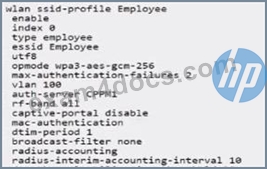
The customer provided the current configuration and reported their non-loT 802. IX devices are no longer able to connect. Which configuration change can be made to fix the issue?
- A. Add i2-autn-fairtnrougn to the WLAN configuration
- B. Remove mac-authentication from the WLAN configuration
- C. Modify opmode wpa3-aes-gcm-256 to opmode wpa2-aes
- D. Modify max-authentication failures to 0.
Answer: B
Explanation:
The existing configuration for the WLAN ssid-profile has enabled MAC authentication which, while suitable for IoT devices that may not support 802.1X, can interfere with the normal 802.1X authentication process for other devices. By removing themac-authenticationdirective from the WLAN configuration, the non-IoT
802.1X devices should be able to connect without issues as the authentication process will not be disrupted by MAC authentication checks. This adjustment ensures that the WLAN ssid-profile is correctly aligned with the authentication requirements for both IoT and non-IoT devices within the network environment, conforming to the best practices for mixed-device WLAN configurations.
NEW QUESTION # 72
Your customer's employees connected to a wired network are complaining about a poor user experience. The customer has UXI sensors deployed on their premises. These sensors nave been running for multiple months.
They are testing both the wired network (using the wired Interface of each sensor) and the wireless networks.
Your customer used the UXI dashboard to find the reason for the poor user experience to find more details, the customer asked you to check the packet captures that have been downloaded from the sensors using the UXI dashboard.
From the zip file downloaded from the UXI sensors, you checked the "datagrams" .pcap file, but you were not able to find any issues How can you explain this?
- A. The default filers of the packet captures do not allow tailed tests to be captured by the sensor
- B. The UXI sensor could not upload the latest test results to the cloud, so the packet capture is outdated
- C. The datagrams captured on the physical Ethernet interface are in a different .pcap file.
- D. The "datagrams- pcap file only contains me successful tests Failed tests are contained in the "datagrams- failed" .pcap file
Answer: D
Explanation:
It is a common practice to separate successful and failed test results into different files for ease of troubleshooting. If the "datagrams.pcap" file shows no issues, it's likely because it only contains successful test data, and the failed tests that could explain the poor user experience would be in a different file, such as
"datagrams-failed.pcap."
NEW QUESTION # 73
Which option shows the correct Banawidth Control for 1024 kbps down and 2048 Kops up for the SSID?
- A.

- B.

- C.

- D.
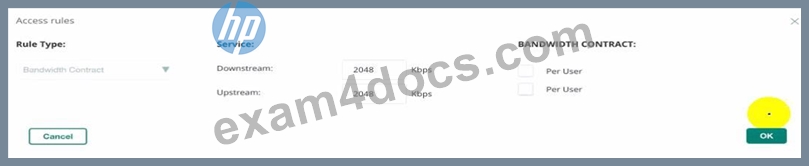
Answer: B
Explanation:
The correct Bandwidth Control settings for 1024 Kbps down and 2048 Kbps up for the SSID are shown in Option D. In Option D, the downstream is set at 1024 Kbps and the upstream at 2048 Kbps, both configured per user, which matches the requested configuration. This setup ensures that each user has a guaranteed bandwidth allocation of the specified rates when connected to the SSID, providing a controlled and predictable user experience.
NEW QUESTION # 74
Exhibit.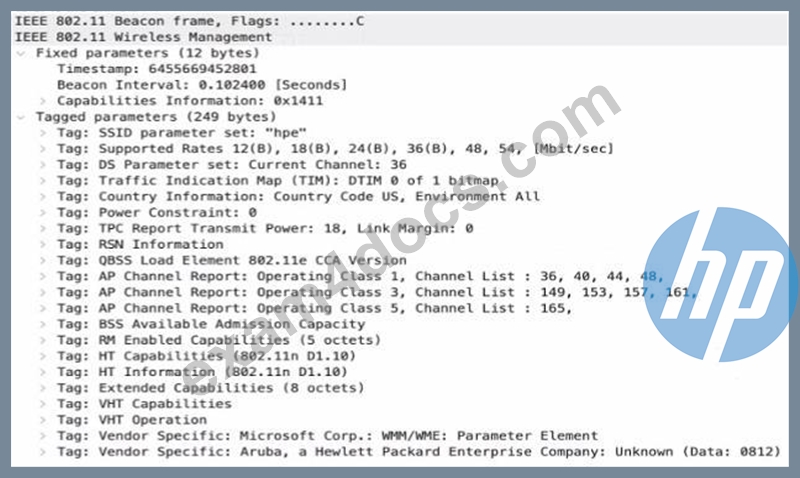
Which statement is true?
- A. The SSID supports 802 11ax clients.
- B. The SSID supports 802 11ac clients.
- C. The SSID is supports 6 GHz clients.
- D. The SSID supports HR-DSSS data rates
Answer: A
Explanation:
The exhibit shows that the SSID supports 802.11ax clients, which is indicated by the presence of HT (High Throughput) information, VHT (Very High Throughput) capabilities, and HE (High-Efficiency) operation, which are all features associated with 802.11ax, also known as Wi-Fi 6.
NEW QUESTION # 75
A customer wan a gateway connected to a device on gigabitethernet0/0/3 configures an Asset ID TLVon the device for inventory management.
Exhibit.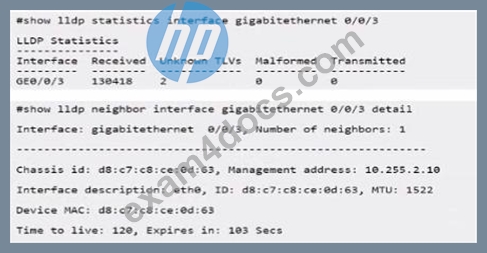
The customer mentions me Asset ID is not shown What is causing the issue?
- A. MTU size is too small.
- B. Unknown TLVs cannot be displayed.
- C. LLPD-MED needs to be enabled.
- D. LLDP TX is not enabled.
Answer: B
Explanation:
The issue is that unknown TLVs (Type Length Values) cannot be displayed. LLDP (Link Layer Discovery Protocol) is used to share device information with network neighbors, but if a TLV is not recognized by the LLDP implementation on the gateway, it won't be displayed or processed. Hence, the Asset ID TLV set on the device for inventory management is not showing up because it is unrecognized or unsupported by the gateway's LLDP.
NEW QUESTION # 76
A customer wan a gateway connected to a device on gigabitethernet 0/0/3 configures an Asset ID TLV on the device for inventory management.
Exhibit.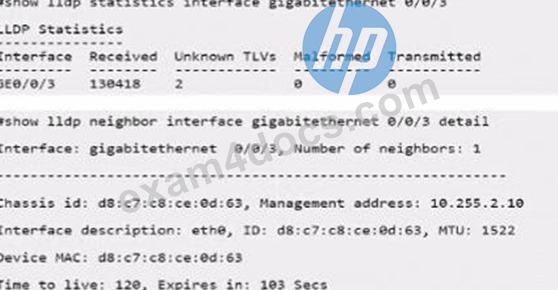
The customer mentions me Asset ID is not shown What is causing the issue?
- A. MTU size is too small.
- B. Unknown TLVs cannot be displayed.
- C. LLPD-MED needs to be enabled.
- D. LLDP TX is not enabled.
Answer: B
Explanation:
The issue is that unknown TLVs (Type Length Values) cannot be displayed. LLDP (Link Layer Discovery Protocol) is used to share device information with network neighbors, but if a TLV is not recognized by the LLDP implementation on the gateway, it won't be displayed or processed. Hence, the Asset ID TLV set on the device for inventory management is not showing up because it is unrecognized or unsupported by the gateway's LLDP.
NEW QUESTION # 77 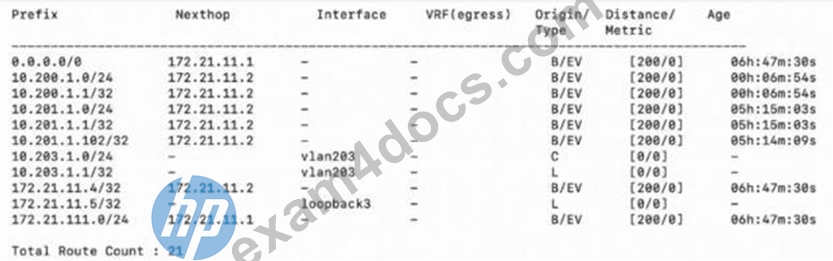
Which statement is true given the following CLI output from a CX 6300?
- A. The overlay loopback addresses are advertised in the fabric with 24-bit subnet masks
- B. A wired client with IP address 10.203.1.100 is on a remote CX 6300 in the fabric with loopback IP address 172.21.11.2
- C. A wired client with IP address 10.203.1.100 has a host route that is not being properly advertised
- D. There are no active fabric clients on the CX switch with RD 172.16.10.1
Answer: B
Explanation:
The CLI output shown is from the Aruba CX 6300 running AOS-CX, displaying the routing table in an EVPN-VXLAN fabric environment.
Key details from the output:
Prefix Nexthop Interface Origin/Type Distance/Metric
10.203.1.0/24 - vlan203 C [0/0]
10.203.1.1/32 - vlan203 L [0/0]
10.203.1.100/32 172.21.11.2 - B/EV [200/0]
172.21.11.4/32 172.21.11.2 - B/EV [200/0]
172.21.11.5/32 - loopback3 L [0/0]
From this, we can interpret the following:
* Routes marked as B/EV originate from BGP EVPN, meaning they are advertised and learned over the VXLAN fabric.
* The next hop 172.21.11.2 indicates that these routes are learned from another fabric device with loopback address 172.21.11.2.
* The route 10.203.1.100/32 is a host route (specific endpoint) reachable via that remote switch.
According to the Aruba CX EVPN-VXLAN Fabric Deployment Guide:
"In a VXLAN fabric, host routes (/32) are dynamically advertised using EVPN Type 2 routes.
These routes include MAC/IP bindings of endpoints connected to remote VTEPs (loopbacks).
The next-hop address in the routing table corresponds to the VTEP IP (loopback address) of the remote switch where the client resides." Thus, the presence of a /32 route (10.203.1.100/32) with next hop 172.21.11.2 indicates that this wired client resides behind another CX 6300 fabric node whose VTEP address is 172.21.11.2.
Option Analysis:
* A. Correct - The /32 route confirms that 10.203.1.100 is reachable via remote CX at 172.21.11.2 (remote VTEP).
* B. Incorrect - The RD information isn't shown here; this statement cannot be validated and contradicts visible EVPN entries.
* C. Incorrect - The route is properly advertised and reachable via EVPN; no indication of advertisement failure.
* D. Incorrect - Overlay loopbacks (172.21.11.x) are advertised as /32 host routes, not /24 subnets.
Final Verified answer: A
Reference Sources (HPE Aruba Official Materials):
* Aruba AOS-CX EVPN-VXLAN Fabric Deployment and Configuration Guide
* Aruba CX 6300 Routing and BGP Configuration Guide
* Aruba Certified Switching Professional (ACSP) Study Guide - EVPN-VXLAN Route Interpretation
NEW QUESTION # 78
in a WLAN network with a tunneled SSID. you see the following events in HPE Aruba Networking Central: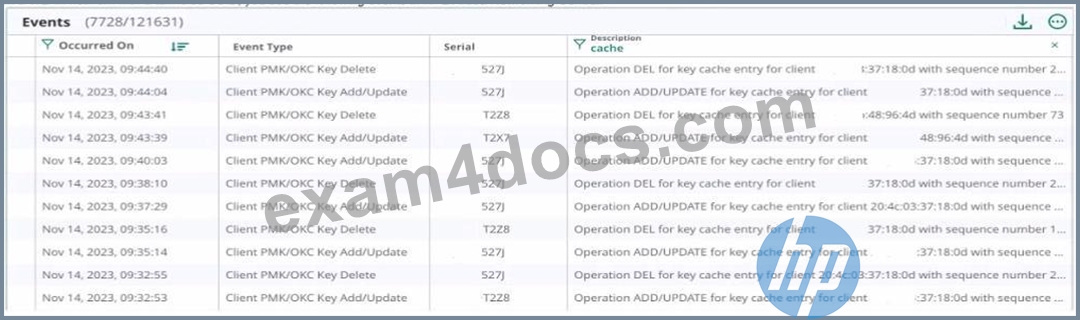
The customer asks you to investigate log messages What should you tell them?
- A. This is normal, expected behavior. No further actions are needed.
- B. This indicates a security issue. The client with a MAC address ending with 37 18;0d Is performing a Denial-of-Service attack on your network. You should track down the client and remove it from the network.
- C. There is a roaming issue Enable Fast Roaming 802.11r and OKC to resolve the issue.
- D. This indicates a client WLAN driver issue for the client with a MAC address ending with 37:18
:Od. You should upgrade the client WLAN driver.
Answer: A
Explanation:
The event log showing PMK (Pairwise Master Key) and OKC (Opportunistic Key Caching) key add/update and delete operations is indicative of normal client behavior in a WLAN environment. These events are part of the standard process for maintaining client session security and do not necessarily indicate any issue.
NEW QUESTION # 79
A manufacturing company depends on FTP, email, and RDP services, which are accessed locally. On Monday morning, RDP sessions are not responsive when users on the employee WLAN download their email and large files from the FTP server simultaneously. The network administrator concludes that the mobility gateway's uplinks are congested when that happens.
Which would be the best option the network engineer can propose in the implementation plan to improve RDP responsiveness?
- A. Update the employee user role with an ACL on position 3 that puts RDP traffic to a high-priority queue and all other traffic to a low-priority queue
- B. Update the spanning-tree configuration from enabled to disabled on the gateway's link aggregation to increase the available bandwidth and avoid congestion
- C. Set the WMM voice DSCP value on the employee WLAN to 56 and enable the RDP application layer gateway
- D. Change the employee WLAN from tunneled to bridged so that the bottleneck in the mobility gateways is removed
Answer: A
Explanation:
Comprehensive and Detailed Explanation (Verified Extract from HPE Aruba Networking Mobility and Switching Documentation) In Aruba mobility deployments, traffic prioritization and QoS are key to maintaining performance for latency-sensitive applications like Remote Desktop Protocol (RDP) when the mobility gateway uplinks become congested.
By default, Aruba gateways treat all user traffic equally unless QoS policies are applied. The best way to ensure critical applications such as RDP are prioritized is by defining Access Control Lists (ACLs) with traffic classification and queue assignments within the user role.
The command:
user-role Employee
access-control-list position 3 <ACL name>
and corresponding ACL entries can assign RDP (TCP port 3389) to high-priority queues and relegate less time-sensitive traffic (like FTP or email) to lower-priority queues.
ArubaOS and Gateway Documentation Extract:
"When user roles are configured with ACLs that include QoS queue assignment, the mobility gateway can prioritize latency-sensitive applications (e.g., RDP, voice, video) by assigning traffic to higher priority queues. This ensures responsiveness during uplink congestion." Changing the WLAN from tunneled to bridged (Option B) could bypass gateway bottlenecks but would also remove centralized security and traffic control, which is not a best practice for enterprise-managed WLANs.
Disabling spanning tree (Option D) has no effect on QoS or congestion; it affects loop prevention only.
Setting the WMM voice DSCP value (Option C) would only influence wireless airtime QoS, not gateway uplink queuing.
Option Analysis:
* A. # Correct - ACL-based traffic prioritization in the employee role directly addresses congestion by ensuring RDP traffic is queued higher.
* B. Incorrect - Changing SSID mode removes central visibility and security.
* C. Incorrect - WMM controls radio-level prioritization, not gateway uplink congestion.
* D. Incorrect - Spanning tree setting is unrelated to uplink queuing or throughput.
# Final Verified answer: A
# Reference Sources (HPE Aruba Official Materials):
* ArubaOS 10 Mobility and Policy Enforcement Guide - User Roles, ACLs, and QoS Prioritization
* Aruba Certified Mobility Professional (ACMP) Study Guide - Traffic Management and Application Prioritization
* Aruba Mobility Gateway Configuration Guide - QoS Queuing and Traffic Classification
NEW QUESTION # 80
Based on best practices if an SSID is configured Tor a primary and secondary gateway cluster with cluster preemption enabled, which will decide if the APs move to the secondary gateway cluster if all of the nodes in the primary gateway cluster are down?
- A. every AP individually
- B. tunnel orchestrator for LAN tunnel service in HPE Aruba Networking Central
- C. cluster leader in the secondary gateway cluster
- D. cluster leader in the primary gateway cluster
Answer: A
Explanation:
In an Aruba network, if an SSID is configured for a primary and secondary gateway cluster with cluster preemption enabled, each AP individually will decide to move to the secondary gateway cluster if all of the nodes in the primary gateway cluster are down. This decentralized decision-making process enhances network resilience and ensures uninterrupted service for clients connected to the APs.
NEW QUESTION # 81
Refer to the exhibit.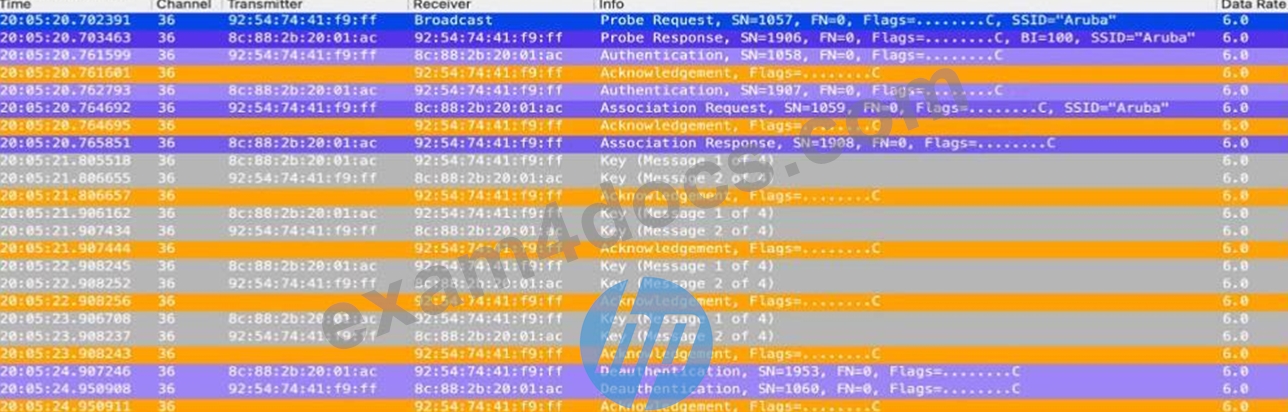
Which statement is true?
- A. The client is using BSS Fast Transition
- B. The client is failing 802.1X authentication
- C. The client used an incorrect passphrase
- D. The client performed passive scanning
Answer: B
Explanation:
The exhibit shows a series of 802.1X authentication steps with multiple "Deauthentication" frames, which indicate that the client is not successfully completing the authentication process. Since the frames show repeated attempts at authentication followed by deauthentication, this suggests that the client is failing the
802.1X authentication process, which is required for network access in a WPA2/WPA3-Enterprise security environment.
NEW QUESTION # 82
A deployment using AP-635S is connected to a stack of CX 6300s as shown.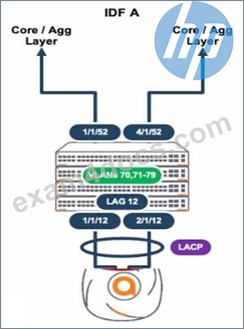
The output of the snow LACP interfaces shews the following: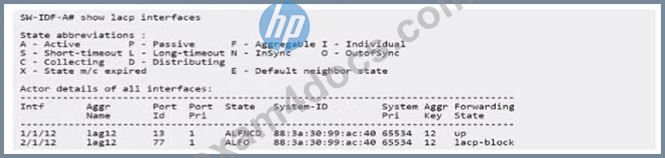
What is causing this issue?
- A. Each AP interface is connected to a routed-only interlace on different networks
- B. e0 is connected to a smart rate interface, and e1 is connected to a non-smart rate interface.
- C. The AP is configured with LACP active
- D. Spanning tree and loop protect are enabled on both AP uplink ports.
Answer: C
Explanation:
In an Aruba deployment, if an AP's interfaces show different LACP states, it often indicates a configuration mismatch. If one interface is up and the other is blocked as shown in the output, it's likely due to both interfaces on the AP being set to LACP active mode, which is a correct setting for establishing an LACP channel with Aruba switches like the CX 6300 series.
NEW QUESTION # 83
Exhibit.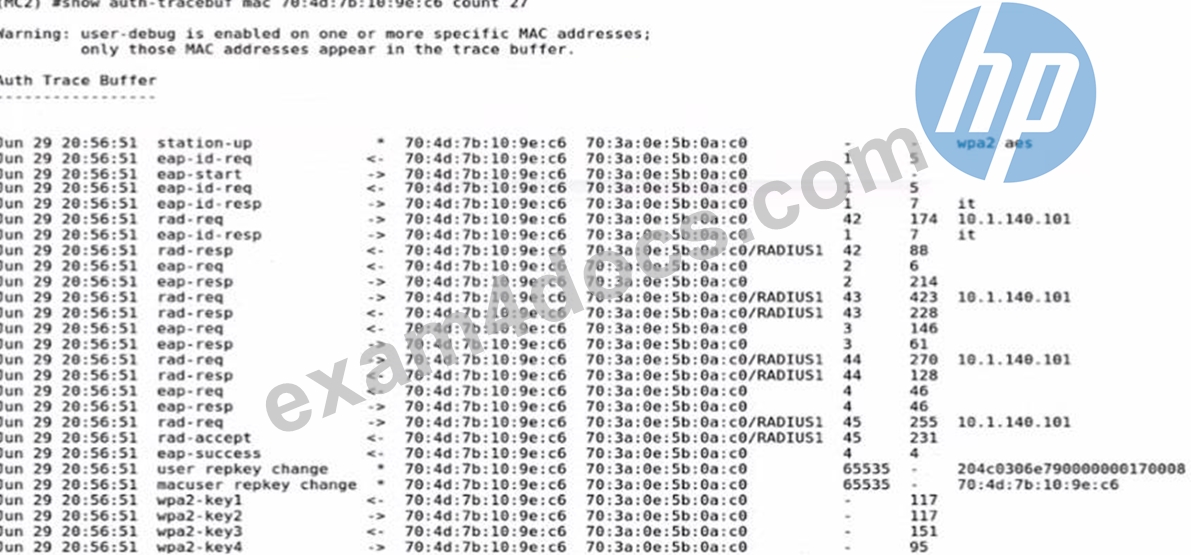
Which wireless connection phase has Just been completed?
- A. L2 authentication and encryption
- B. L3 authentication and encryption
- C. 802.11 enhanced open association
- D. MAC Authentication and 4-way handshake
Answer: A
Explanation:
The wireless connection phase that has just been completed is L2 authentication and encryption. This phase includes processes such as the Extensible Authentication Protocol (EAP) exchange, RADIUS requests and responses, and the 4-way handshake which is characteristic of WPA2-AES encryption.
NEW QUESTION # 84
......
HP HPE7-A07 Exam Syllabus Topics:
| Topic | Details |
|---|---|
| Topic 1 |
|
| Topic 2 |
|
| Topic 3 |
|
| Topic 4 |
|
| Topic 5 |
|
| Topic 6 |
|
| Topic 7 |
|
| Topic 8 |
|
HPE7-A07 dumps Exam Material with 127 Questions: https://braindumps.exam4docs.com/HPE7-A07-study-questions.html
